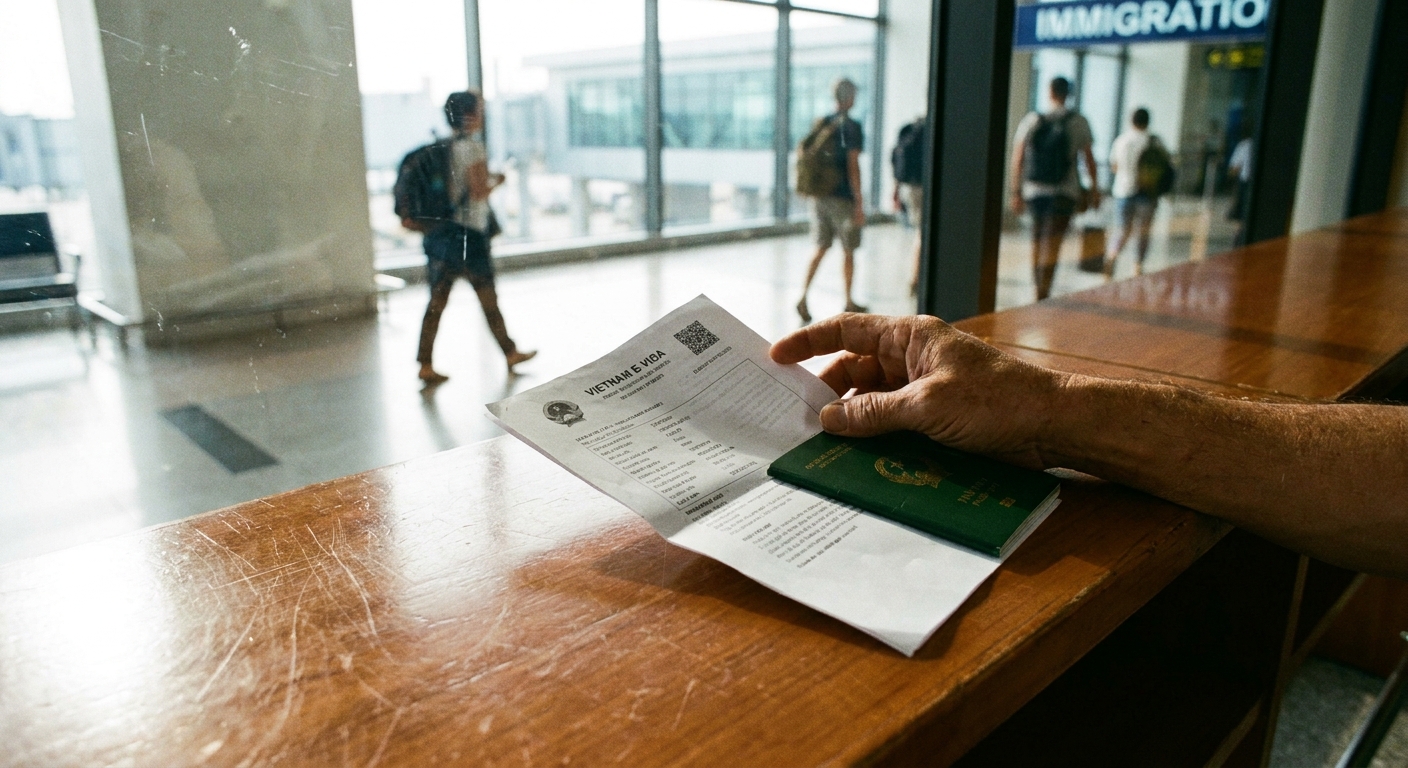
Most Vietnam e-visa photos are rejected for one of four reasons: the wrong file format, a background that is not white, glasses, or a photo that is simply too old. The portal’s own rule is short, and this page gives it to you exactly as the government states it, then explains what it means when you are sitting with a phone photo and an upload button.
What the official portal requires
The instruction page at evisa.gov.vn states the requirement in a single sentence, repeated at every step of the form:
Ask online, we answer right awayType your question on this page. No app to install, no number to save.Ask onlineThe visa applicant’s photo must be a recent 4×6 cm image in JPG or JPEG format, with a file size of less than 2MB. The photo should be a front-facing image with no hat, no glasses, in formal attire, and with a white background.
That is the whole official specification. Everything else you read online — pixel minimums, exact head-height percentages, “both ears visible” — comes from agencies and photo apps, not from the portal. Those extras are usually sensible advice, but they are not the rule you are measured against.
| Requirement | What the portal says |
|---|---|
| Size | 4 x 6 cm |
| File format | JPG or JPEG only |
| File size | Less than 2 MB |
| Angle | Front-facing |
| Head covering | No hat |
| Glasses | None |
| Clothing | Formal attire |
| Background | White |
| Age of photo | Recent |
The format rule catches people out
PNG is not on the list. Screenshots, images saved from a chat app and photos exported from some phone galleries are often PNG or HEIC, and the upload will either fail or go through and stall the application later. Check the file extension before you upload, and convert to .jpg if it is anything else. On an iPhone, the Files app will convert a HEIC image when you duplicate it; on Android and desktop, any photo app’s “export as JPEG” does it.
What 4 x 6 cm means for a digital file
4 x 6 cm is the standard Vietnamese print size, and the portal keeps that wording even though you are uploading a file. In practice it describes the shape: a portrait rectangle in a 2:3 ratio, with your head and shoulders filling most of it.
If you want a pixel figure to aim at, 4 x 6 cm at 300 dpi works out to roughly 472 x 709 pixels. Anything at or above that will print and display cleanly. A photo straight from a modern phone camera is far larger than this, which is why the 2 MB limit matters more than the resolution — you may need to reduce the file, not enlarge it.
Also note the portal asks for two uploads, not one: the portrait photo, and a clear scan or photo of your passport data page. The data page image has its own trap — glare from a flash across the laminate is a common reason a file gets queried.
Taking a photo that passes
- Use a plain white wall or sheet, and stand far enough from it that you do not cast a shadow. “Light grey” and “cream” are the two most common near-misses.
- Face the camera square on, with a neutral expression and your mouth closed. Eyes open and clearly visible, no hair across them.
- Take off your glasses, even clear ones. The portal says no glasses, with no exception for prescription lenses.
- Wear something you would wear to an office. “Formal attire” is interpreted loosely in practice, but a vest top or bare shoulders is a risk you do not need to take.
- Head coverings worn for religious reasons are generally accepted, with the face fully visible from the bottom of the chin to the top of the forehead.
- Avoid the selfie. An arm’s-length photo distorts the face and lights it unevenly. Ask someone else to take it, or use a timer and prop the phone up.
- Do not retouch it. Filters, beauty modes and background-removal tools often leave edges that look edited, and the photo is supposed to be unaltered.
The mistakes that cause a resubmission
- Wrong file format — PNG or HEIC instead of JPG.
- A background that is off-white, patterned, or has a visible shadow or wall edge.
- Glasses, sunglasses, or a hat.
- Flash glare or red-eye.
- Blurry or low-resolution images, including photos of a printed photo.
- A photo that is clearly years old and no longer looks like your passport picture.
- Another person, a hand, or part of a room in the frame.
A photo problem usually does not come back as a clean “rejected” message. More often the application simply sits on processing for longer than it should. If yours has stalled, our sister site explains how to check a Vietnam e-visa status and what each result means.
Photos for other Vietnam visa routes
The 4 x 6 cm size is the standard across all of them, but the format differs:
- E-visa: one digital portrait photo uploaded with the form, plus the passport data page.
- Visa on arrival: printed photos handed over at the airport counter for stamping. Bring two identical prints — a phone image is no use at the desk.
- Embassy application: printed photos attached to the paper form, per that embassy’s instructions.
Before you upload
Open the file and check four things: the extension is .jpg, the file is under 2 MB, the background is actually white when you look at it on a bright screen, and you are not wearing glasses. Those four cover most of what goes wrong.
If you would rather have someone look at it first, our application form checks the photo as you upload it and flags the problems above before the application goes anywhere.
Frequently asked questions
Can I use a PNG for a Vietnam e-visa photo?
No. The portal specifies JPG or JPEG. Convert the file before uploading.
How old can the photo be?
The portal says “recent” without naming a period. Agencies and photo services commonly apply a six-month rule, which is a safe standard to hold yourself to.
Does the background have to be pure white?
Yes, white is what the portal specifies. Light grey and off-white are among the most common reasons a photo is sent back.
Can I wear glasses if I need them to see?
The rule says no glasses and does not list a medical exception. Take them off for the photo.
Do I need a professional photo shop?
No. A phone photo against a white wall, taken by someone else in even daylight, meets the specification. A photo shop is simply a faster way to be sure.