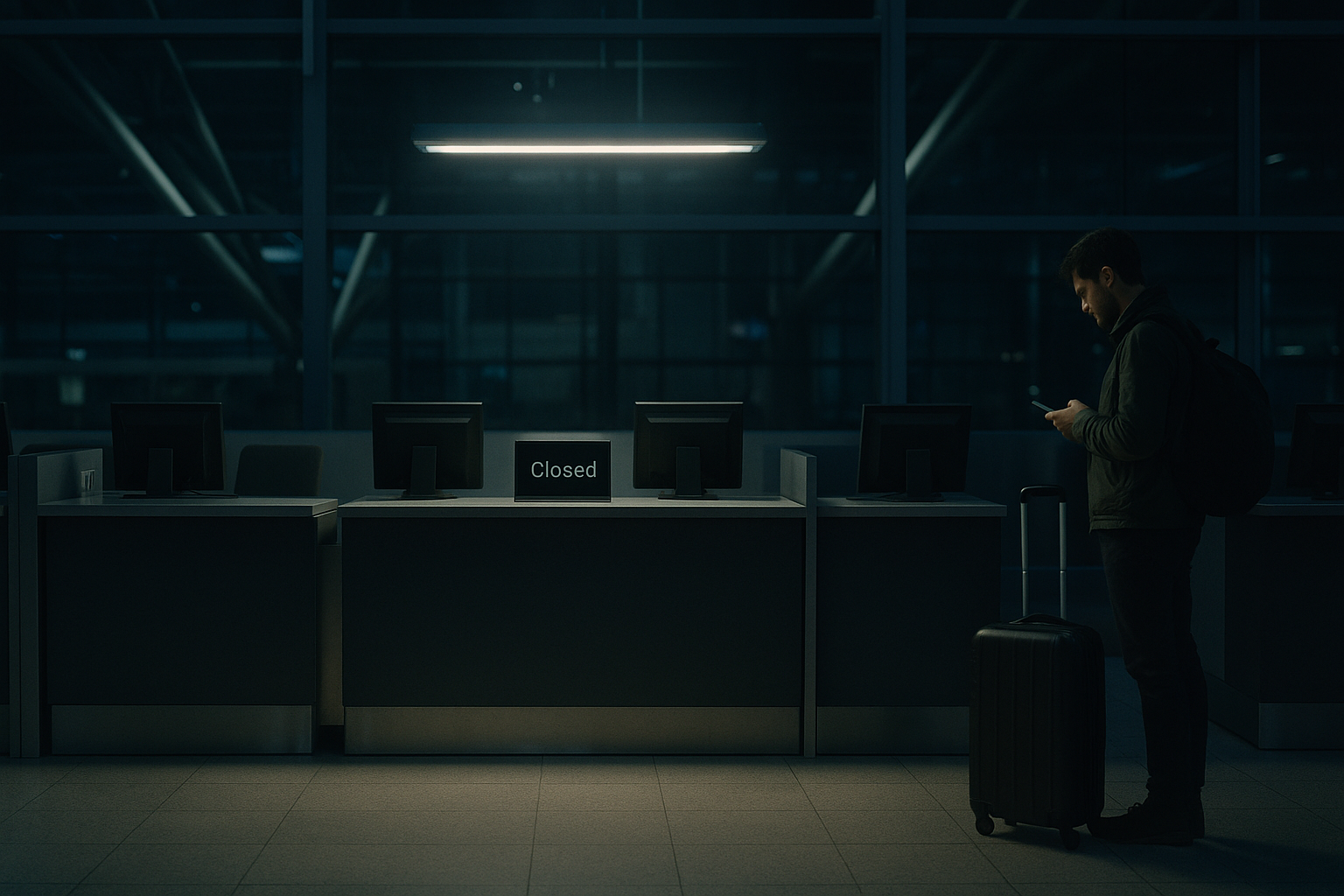
Short answer: most people think a visa problem at check-in costs them one flight. It usually costs more than that. Travel insurance typically excludes it, because entry documents are treated as the traveller’s responsibility. And under the conditions of carriage most major airlines use, not flying the first leg lets them cancel every remaining segment on the ticket, including the flight home. Buying a replacement for the first leg does not undo that — the rest of the itinerary is already gone.
Ask online, we answer right awayType your question on this page. No app to install, no number to save.Ask onlineNobody at the airport explains this. The agent tells you that you cannot board. The consequences arrive later.
What the no-show rule actually does
Airline tickets are built as a sequence of coupons that are expected to be used in order. Skip the first one and the reservation system treats you as a no-show, which under most carriers’ conditions of carriage entitles them to cancel what is left. The practice is long-standing and exists mainly to stop “hidden city” ticketing and to let the airline resell the seat.
The mechanics matter more than the reason. Consider a common routing to Vietnam:
| Segment | What happens if you are refused boarding at the start |
|---|---|
| Auckland → Seoul | Not flown |
| Seoul → Hanoi | Cancelled — the coupon before it went unused |
| Hanoi → Seoul (return) | Cancelled |
| Seoul → Auckland (return) | Cancelled |
This is where the expensive misunderstanding lives. People assume they can buy a new Auckland–Seoul ticket, arrive in time for the original connection, and carry on. They cannot. That Seoul–Hanoi segment was cancelled when the first coupon went unused, and so were both legs home. You would be buying a ticket to an airport where nothing is waiting for you.
Not every carrier applies this identically — fare rules and conditions of carriage vary, and some are more forgiving than others. But it is the default across most major airlines, and assuming you are the exception is an expensive way to find out.
The one thing that sometimes saves the ticket
Call the airline before the first flight departs. A ticket held by someone who phoned ahead is treated differently from one abandoned at the gate, and some carriers will protect the remaining segments or rebook the whole itinerary for a fee. Once the aircraft has pushed back, that option narrows sharply.
So if you are standing at a check-in desk being told you cannot board, the call to make is not to your travel agent an hour later. It is to the airline, then and there.
Why insurance usually does not help
Travel policies are built around events outside your control. Meeting a country’s entry requirements is not treated as one of those. Visa refusal, missing documents and denied boarding for document reasons sit in the exclusions of most standard policies, on the reasoning that verifying entry requirements was the traveller’s job.
This is not universal — policies differ, and “cancel for any reason” cover exists and is priced accordingly. But the default answer on a standard policy is no, and the time to discover which one you hold is while you are still choosing it, not at an airport.
What this does to the arithmetic
The usual way people think about an urgent visa is: the government fee is USD 25, an agency wants more than that, so the agency is expensive.
Set it against what is actually at risk. A long-haul return itinerary with a connection is rarely a small number, and on the routing above the exposure is the whole ticket plus a replacement, with insurance most likely declining. That is the comparison, not fee against fee.
Which is also why the honest advice does not change: if you have three weeks, file it yourself at evisa.gov.vn and keep the service fee. The standard route takes 3 working days and works perfectly well when you have time. What you are buying when you pay someone is a shorter tail on the bad outcomes, and that only becomes worth the money when the outcome would actually be bad.
The tiers, and what nobody can sell you
Vietnam does not sell speed. There is no express fee on the official portal and no priority queue, and a service claiming to offer official fast-track processing is describing something that does not exist — which remains the most reliable way to identify an intermediary worth avoiding.
| Tier | Time | When it makes sense |
|---|---|---|
| Standard e-visa | 3 working days | Flight more than a week away |
| 48 hours | 2 working days | Flight later this week |
| 24 hours | 1 working day | Flying tomorrow or the day after |
| 4 hours | 4 hours | Flying tonight or tomorrow morning |
| 1 hour | 1 hour | Already at the airport |
What an agency does is narrower and real: check the application before it is filed so it does not bounce, submit it inside Hanoi working hours rather than at 2am your time, and file at a weekend when the government portal cannot. That removes the days a mistake would have added. It does not move anyone up the queue.
How people end up at the desk without a visa
Three causes account for most of it, and all three are avoidable days earlier.
- The photo. It rejects more applications than anything else — white background, no glasses, no head covering, ears visible, face straight on. The notice does not tell you which rule you broke: photo rejected.
- A payment that did not go through. Vietnamese gateways decline plenty of European and Australasian cards on first attempt, and a failed payment means no application exists at all. No clock started and nothing tells you: payment failed.
- Reading the wrong country’s rules. An Irish traveller reading British advice, an Austrian reading German advice. The exemption follows the passport, and nine EU countries are not on the list.
If it is already filed and simply slow, that is a different situation and usually a calmer one — see still processing. If it came back rejected, there is no appeal and the fix is a fresh application: rejected and reapplying.
The short version
- Refused boarding over a visa can cost the whole ticket, not one leg — most carriers cancel the remaining segments once the first goes unused
- Buying a replacement first leg does not revive the connection or the flights home
- Call the airline before the flight departs — that is the one move that sometimes protects the rest
- Standard travel insurance usually excludes document failures, including visa refusal and denied boarding
- Compare the cost against the exposure, not against the USD 25 government fee
- With three weeks, file it yourself at evisa.gov.vn — the arithmetic only turns when time is short