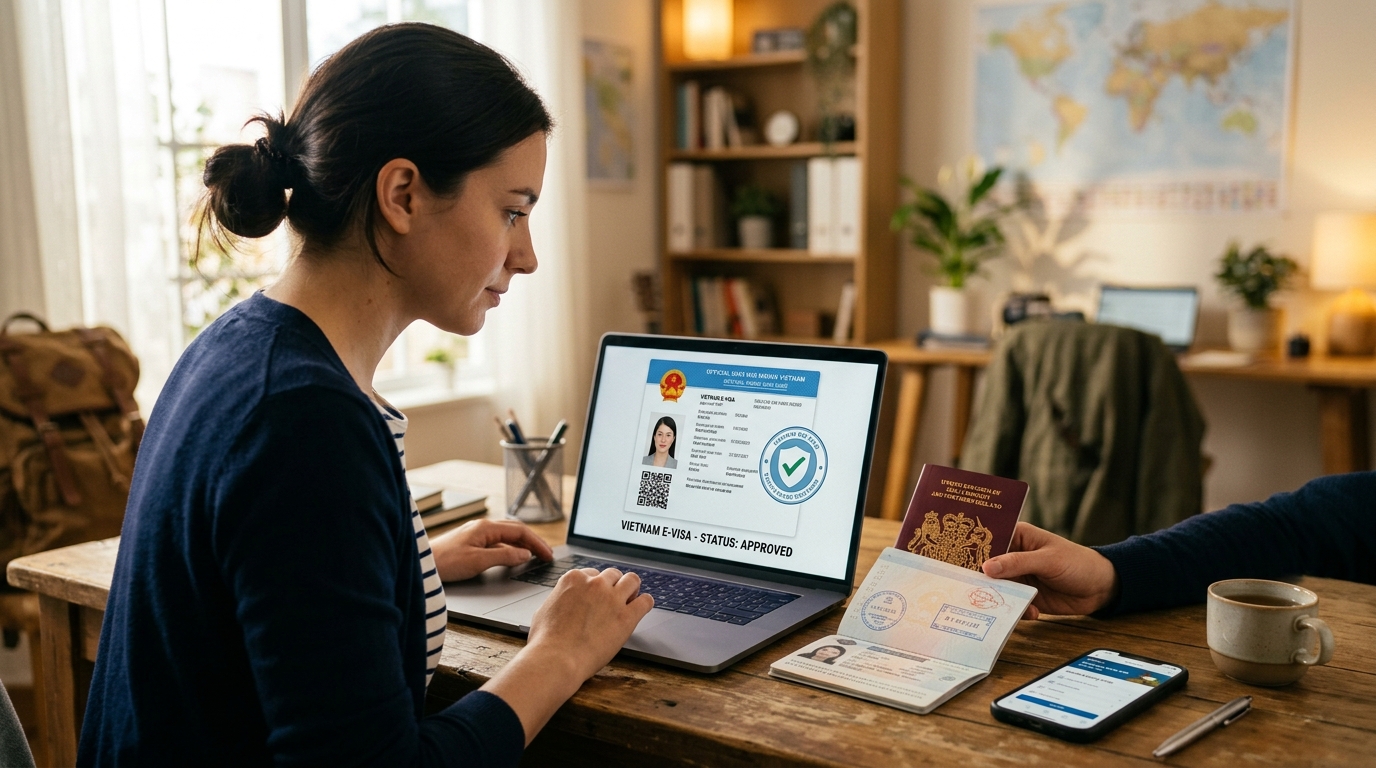
Yes — an urgent Vietnam visa service can be completely legit, and thousands of stressed travelers use one safely every week. The real question behind the search “is urgent Vietnam visa service legit” is not whether such services exist, but how to tell a genuine, licensed agency apart from the look-alike scam sites, fake e-visa PDFs and price-gouging fronts that crowd the search results in 2026. This guide gives you the exact checks so you can move fast without getting burned.
Ask online, we answer right awayType your question on this page. No app to install, no number to save.Ask onlineHere is the honest starting point: for a standard trip with time to spare, the free official portal at evisa.gov.vn is all you need. A paid agency earns its fee when you are short on time and need real expedited handling, or when you want a human to catch mistakes before your application reaches Immigration. A legitimate service is transparent that it is a private company charging a premium above the government fee. A scam pretends to be the government — that single distinction runs through everything below.
Is an urgent Vietnam visa service legit? The 60-second answer
Run any service you are considering through these quick checks. A legitimate urgent Vietnam visa agency will pass all of them; a scam usually fails two or more:
- It does not claim to be the government. A real agency says clearly that it is a third-party service and that the official portal is evisa.gov.vn.
- Its pricing is itemized — the government fee shown separately from the service/rush fee, not hidden inside one inflated “official” total.
- It has a checkable identity — a Vietnamese business registration, a physical address and reachable support, not just a contact form.
- Payment goes through a secure checkout, never to a personal account, crypto wallet or messaging app.
- The approval it delivers verifies on the official portal. If you cannot confirm it at evisa.gov.vn, it is worthless — no matter how genuine the PDF looks.
What you are actually buying: official portal vs a legit agency vs a scam
Understanding the three players makes the scams obvious. The government runs the e-visa system and charges a flat fee. A legitimate agency sits on top of it, doing the work faster and checking it for you. A scam mimics either one to take your money.
| Official portal (evisa.gov.vn) | Legitimate urgent agency | Scam site / fraud | |
|---|---|---|---|
| Who runs it | Vietnam Immigration Department | A registered private company | Anonymous operator |
| Website | Ends in .gov.vn | Own brand domain; states it is not the government | Look-alike domain with “gov” or “official” in a .com/.org/.net |
| What you pay | Government fee only (approx. US$25 single / US$50 multiple entry) | Government fee plus a stated service and rush fee | An inflated flat price with no breakdown |
| Speed | Standard, roughly 3 working days; no expedite | Genuine rush tiers running on Vietnam working hours | Promises any speed, delivers nothing or a fake |
| Weekends / holidays | Effectively closed | Can lodge and chase during limited windows | Takes payment 24/7 regardless |
| Support | None / self-service | Named support, refund policy in writing | Goes silent after payment |
If you want a deeper side-by-side, see official evisa.gov.vn vs a paid agency. The takeaway: paying a real agency is a legitimate convenience choice, not a scam — the fraud is only in the third column.
The 3 scams that target urgent travelers in 2026
Time pressure is exactly what fraudsters exploit. When you are hours from a flight, you skip the checks you would normally make. These are the three schemes to know.
1. Look-alike “government” websites
The most common trap. Scammers buy search ads and build pages that copy the official portal’s colors, seal and layout, using domains like vietnam-evisa-gov.com or evisagov.org. You think you are on the government site; you are not. They either charge US$100–US$200 for a US$25 visa, or take your money and disappear.
The defense is simple: the only official domain ends in .gov.vn (evisa.gov.vn, and the linked thithucdientu.gov.vn). No genuine Vietnamese government visa portal ever uses .com, .org or .net. Do not reach the site through a Google ad — type the address or use a link from your own government’s travel advisory, which points to evisa.gov.vn.
One nuance trips people up: a .com address is not itself proof of a scam — every legitimate agency, including this one, uses a .com brand. The red flag is a .com site pretending to be the government.
2. Fake or altered e-visa PDFs
Some operators send back a polished PDF that looks like a granted e-visa — correct fonts, a QR code, a reference number — but was never issued by Immigration. Travelers only discover it at the airport, where the airline or border officer cannot find the record. By then it is too late.
A real e-visa exists in the government database, not just in your inbox. Never treat a PDF as proof on its own. Verify every approval directly on the official portal (steps below).
3. Fake urgency — paying a premium for no real speed
This is the scam specific to urgent buyers. A site advertises a “1-hour” or “2-hour” visa, charges a heavy rush fee, then submits the same standard application the free portal would — or does nothing at all. Genuine speed depends on Vietnam Immigration’s working hours (UTC+7, Monday to Friday). A promise of a guaranteed one-hour turnaround at 2am on a Sunday describes something Immigration does not do. For what fast tiers actually cost and deliver, read the real all-in cost of a 1-hour and 2-hour Vietnam visa.
How to verify an urgent Vietnam visa agency is legit
Before you pay anyone, run this checklist. It takes about five minutes and rules out most fraud.
- Check the domain and the disclaimer. A legit agency plainly states it is a private service and names evisa.gov.vn as the official portal. If a .com site claims to be “the official government website,” leave.
- Find the company behind it. Look for a Vietnamese business registration number, a physical office address and a real support channel. No identity, no trust.
- Read independent reviews. Check Trustpilot, Google and travel forums like Tripadvisor and Reddit — not just testimonials on the agency’s own page. Look for recent, detailed reviews and how the company handles problems.
- Confirm the pricing is itemized. You should see the government fee separately from the service and rush fees. A single inflated “all-in official fee” with no breakdown is a warning sign.
- Test responsiveness before paying. Send a question. A legitimate urgent service answers quickly and specifically; a scam is vague or pushes you to pay immediately.
- Read the refund policy. Reputable agencies publish what happens if an application is not approved. See how refunds work if your urgent visa is not approved.
How to verify your Vietnam e-visa approval is genuine
This step catches fake PDFs, and it works no matter who you applied through. A genuine e-visa is a record in Vietnam’s system, so confirm it there:
- Go directly to evisa.gov.vn and open the e-visa search / status page.
- Enter your registration code, the email used on the application and your date of birth.
- A valid, approved visa shows a status such as “Granted” and lets you download the official document.
- Check that your name, passport number, entry/exit dates and entry type (single or multiple) are exactly right. A single wrong character can cause a boarding refusal.
Two 2026 details worth knowing. First, the e-visa is now valid at around 83 international ports of entry (roughly 17 airports, 27 land crossings and 39 seaports) after the December 2025 expansion, and newer e-visas no longer lock you to one fixed port — but always confirm your intended crossing is covered. Second, a separate digital arrival card has been running at Tan Son Nhat (SGN) since April 2026, where the Vietnamese government describes it as encouraged rather than mandatory; it may be rolled out to other airports with little notice. It is free, filed on the government’s pre-arrival portal (prearrival.immigration.gov.vn), which only accepts an arrival date of today or the next two days, and does not replace your visa. Any service demanding a large extra fee to “complete your arrival card” is overreaching.
Red-flag pricing: what is normal and what is not
Price alone tells you a lot once you know the baseline. The government fee is roughly US$25 for a single-entry e-visa and US$50 for multiple entry. A legitimate agency adds a service fee, and more for faster tiers — that premium is the cost of the work, the checking and the speed. Two patterns should stop you:
- Too expensive while posing as official. A “government” site charging US$100–US$200 for a US$25 visa is a look-alike, not a bargain gone wrong.
- Too cheap to be real. A price at or below the government fee, from a third party that also promises to do the work, usually means a bait price, hidden charges later, or a fake.
Judge value on the total and the transparency, not the sticker. A fair, itemized premium from a checkable company is normal; a mystery flat fee is not. For how to speed up an application you have already started, see how to expedite a pending Vietnam e-visa.
Secure payment: what a legit service asks for — and never asks for
One myth to clear up first: paying by card is not a scam signal. The official portal itself accepts Visa, MasterCard and UnionPay through a secure gateway, and so do legitimate agencies. The danger is how you are asked to pay.
Green flags: a secure (HTTPS) checkout, a recognized payment processor, card payment with 3-D Secure, and a clear receipt. Red flags: requests to send money to a personal bank account, cryptocurrency, gift cards, or a transfer via WhatsApp, Telegram or Western Union to an individual. No legitimate visa service is paid that way. If a “rush fee” must be wired to a named person to “release” your visa, it is a scam.
Legit and genuinely urgent: can the service actually move fast?
A service can be honest and still not be fast. Since your whole reason for paying is speed, confirm the urgency is real:
- Speed is tied to Immigration’s working hours. Genuine expedite happens Monday–Friday, Vietnam time. An agency that is candid about weekend and holiday limits is being truthful, not weak.
- Rush tiers are described precisely — for example a one-working-day, same-day or few-hour option — rather than a blanket “instant, guaranteed” claim.
- They ask the right questions about your flight time, nationality and entry port, because those determine what is genuinely possible.
For the full playbook on moving quickly the legitimate way, see the complete fast-track guide and the pillar guide, the complete 2026 emergency and urgent Vietnam visa guide. If a previous application was refused, do not panic-buy from the first pop-up — reapply the right way after a rejection instead.
What to do if you think you have been scammed
If you have already paid a suspicious site, act quickly. Contact your bank or card issuer to dispute the charge — card payments are often reversible — and keep every screenshot and receipt. Stop sending any further “fees.” Do not travel on an unverified PDF: confirm your status on evisa.gov.vn, and if there is no record, apply properly through the official portal or a verified agency. If a visa problem could push you past your permitted stay, know that overstaying now carries steeper penalties under Vietnam’s 2026 rules, covered in the 2026 overstay fines guide.
Start an urgent application with confidence
A legitimate urgent Vietnam visa service is transparent about being a paid agency, itemizes its fees, takes payment securely, communicates like a human and delivers an approval you can verify on the government portal. If a service meets that bar, using it to save time under pressure is a smart, safe choice — not a gamble. When you are ready, start your urgent Vietnam visa application with a service that shows its work, and verify your approval on evisa.gov.vn before you fly.
Ask online, we answer right awayUnusual case, or flying tomorrow? Ask before you order.Ask onlineFrequently asked questions
Is evisa.gov.vn the only official Vietnam visa website?
For the e-visa, yes. The official government portal is evisa.gov.vn (with the linked thithucdientu.gov.vn), and any official Vietnamese immigration site ends in .gov.vn. Sites ending in .com, .org or .net are never the government. A legitimate agency uses a .com brand but tells you plainly that it is a paid third-party service and points you to evisa.gov.vn as the official portal.
Are Vietnam visa agencies a scam, or are some legit?
Many are legitimate. A real agency is a registered company that submits your application, checks it and offers faster processing for a stated fee above the roughly US$25 government charge. A scam pretends to be the government, hides its fees, or sells a fake approval. The difference is transparency: a legit service says who it is, itemizes its pricing and delivers an approval you can verify on evisa.gov.vn.
How do I check that my Vietnam e-visa is genuine and not a fake PDF?
Do not rely on the PDF alone. Go to evisa.gov.vn, open the e-visa search page, and enter your registration code, the email used on the application and your date of birth. A genuine, approved visa shows a status such as “Granted” and lets you download the official document. If there is no record in the system, the PDF is worthless, even if it looks perfect.
Why does an agency charge more than the government fee?
The extra amount is a service and rush fee, not the visa itself. You are paying for someone to prepare and lodge the application correctly, chase it during Vietnam working hours and offer faster tiers than the standard three-working-day process. A fair agency shows the government fee (roughly US$25 single or US$50 multiple entry) separately from its own charge. Be wary of a single inflated total presented as the “official” price with no breakdown.
Can a legitimate service really get an urgent Vietnam visa on a weekend or holiday?
Only within limits. Vietnam Immigration processes applications during working hours (UTC+7, Monday to Friday) and is effectively closed on weekends and public holidays, so no honest service can guarantee a fully processed visa at 2am on a Sunday. A trustworthy agency is candid about these constraints and lines your application up to move the moment offices reopen, rather than promising the impossible.
What payment methods are a red flag for a Vietnam visa scam?
Paying by card is normal and safe. The danger sign is being asked to send money to a personal bank account, a cryptocurrency wallet, gift cards, or via WhatsApp, Telegram or Western Union to an individual. No legitimate visa service is paid that way. Use a secure checkout with a recognized processor and 3-D Secure, and never wire a “rush fee” to a named person to “release” a visa.