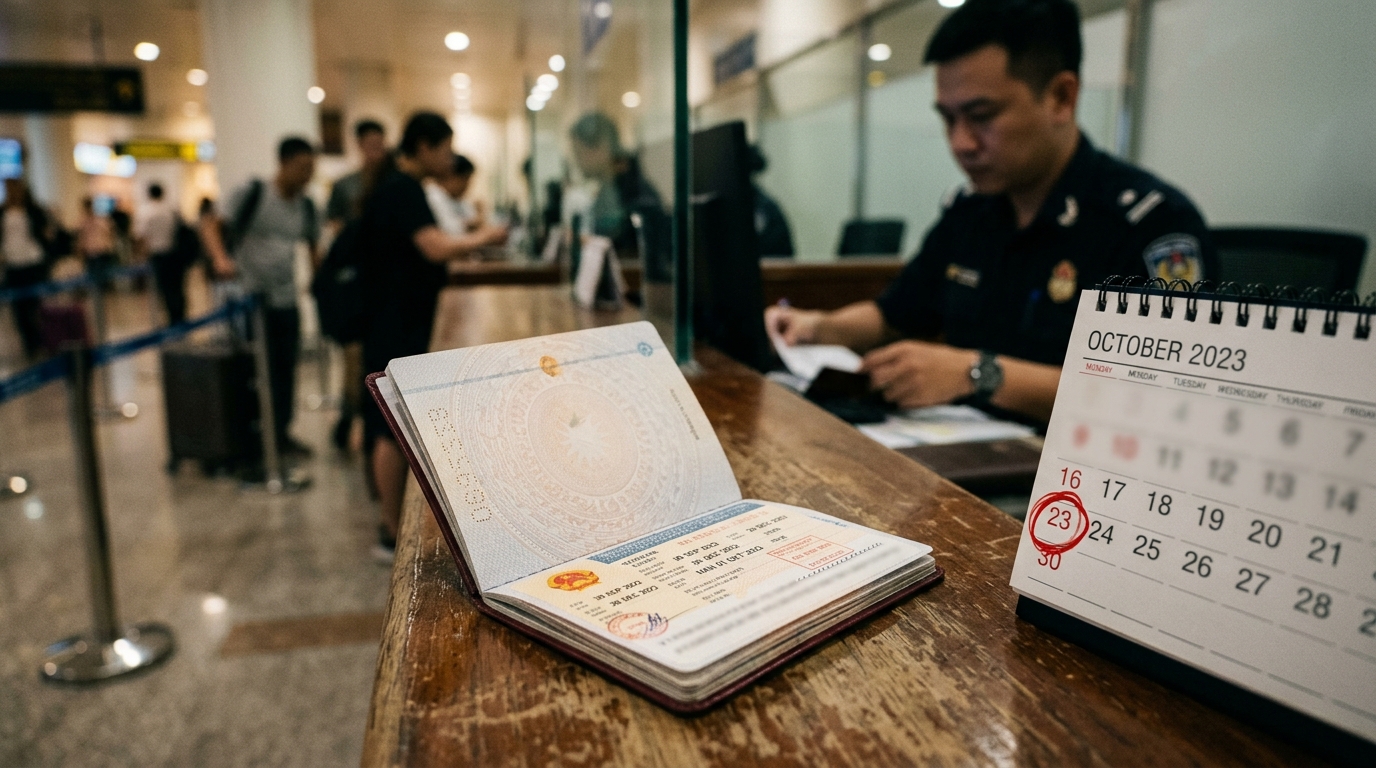
The Vietnam visa overstay fine in 2026 ranges from VND 500,000 to VND 40,000,000 (roughly US$19 to about US$1,520), depending on how many days you have stayed past your visa’s expiry. Since 15 December 2025, a new decree (Decree 282/2025/ND-CP) has replaced the older 2021 penalty rules and roughly doubled the maximum fine, so almost every pre-2026 fine table you will find online is now out of date.
Ask online, we answer right awayType your question on this page. No app to install, no number to save.Ask onlineIf your visa is about to expire, or has just lapsed, stay calm and read on. This guide explains exactly what you can be charged, what happens at the airport, how the fine-and-exit process actually works, and the re-entry ban risk you need to take seriously. It also covers the fastest legal way to fix the problem before it turns expensive.
How much is the Vietnam visa overstay fine in 2026?
Vietnam now runs a tiered penalty system: the longer you overstay, the steeper the fine. The bands below reflect the 2026 rules under Decree 282/2025. Immigration officers set the exact amount within each band based on the circumstances, so treat the ranges as the framework, not a fixed receipt.
| Overstay length | Fine (VND) | Approx. USD* | What to expect |
|---|---|---|---|
| Under 16 days | 500,000 – 2,000,000 | ~$19 – $76 | Usually a minor administrative fine, often settled on exit |
| 16 to under 30 days | 5,000,000 – 10,000,000 | ~$190 – $380 | Deportation now legally possible; higher scrutiny |
| 30 to under 60 days | up to 15,000,000 | up to ~$570 | Fine plus a likely exit-visa procedure |
| 60 to under 90 days | up to 20,000,000 | up to ~$760 | Serious; deportation and ban risk climbs |
| 90 days to under 6 months | up to 25,000,000 | up to ~$950 | Treated as a serious violation |
| 6 months to under 1 year | up to 30,000,000 | up to ~$1,140 | Severe; entry ban very likely |
| 1 year or more | up to 40,000,000 | up to ~$1,520 | Maximum penalty; deportation plus a multi-year ban |
*USD figures are approximate and move with the exchange rate. The legal amounts are fixed in Vietnamese dong. There is no simple flat “per day” rate in 2026: the penalty is banded, so the jump from day 15 to day 16 is far larger than the daily drift within a band.
What changed: Decree 282/2025 vs the old 144/2021 rules
Until late 2025, foreigner overstay penalties sat under Decree 144/2021, which capped the overstay fine at around VND 20 million. From 15 December 2025, Decree 282/2025/ND-CP replaced those provisions and lifted the ceiling to VND 40 million for the longest overstays. It also gave immigration authorities clearer power to impose deportation on foreigners who overstay by 16 days or more.
This is the freshness trap for travellers researching a Vietnam overstay penalty in 2026: many well-ranked pages still show the old VND 20 million cap and a three-row table. The current structure is both higher and more granular, which matters most if you are weeks rather than days over.
What happens at the airport when you overstay
The outcome at departure depends almost entirely on how long you have overstayed. Two very different scenarios play out.
A short overstay (a day or two)
A very short, honest overstay is usually treated as a minor administrative matter. In many cases the immigration officer at the departure gate can process the fine on the spot: you explain, you pay (typically in cash, dong or US dollars), you get your exit stamp, and you fly. Bring more cash than you think you need and arrive early, because settling the paperwork takes time you may not have before boarding.
Do not assume this is guaranteed. Under the tightened 2026 enforcement, officers have discretion, and even a short overstay can be referred to a proper administrative process. The safe assumption is that the more days you are over, the less likely a quick airport settlement becomes.
A longer overstay (roughly a week or more)
If you are meaningfully over, you generally cannot just turn up at the airport and pay your way out. The standard route is:
- Go in person to the Vietnam Immigration Department office (in Hanoi, Ho Chi Minh City or Da Nang) with your passport.
- Explain the overstay, often in a short written letter, and pay the administrative fine there.
- Be issued an exit visa (exit permit) that legally authorises your departure, commonly valid for a short window such as 7 to 15 days.
- Only then travel to the airport and leave within that window.
Skipping this and hoping to sort it at the gate risks being turned back at immigration, missing your flight, and compounding the overstay. If you are already several days past expiry, start the Immigration Department process before you book a firm departure.
Deportation and re-entry ban risk
A fine is only part of the exposure. The bigger long-term cost of overstaying a Vietnam visa is what it does to your record.
- Deportation. Decree 282/2025 allows immigration authorities to deport foreigners who overstay by 16 days or more, depending on severity. Separately, Decree 59/2026/ND-CP, in force from 1 April 2026, sets out the deportation framework for administrative violations such as overstay, unauthorised work and visa misuse, and reportedly allows immediate deportation where a person cannot pay the fine. In practical terms: carry enough funds to settle any penalty.
- Re-entry ban / blacklist. Overstays can land you on the immigration blacklist. Reported ban durations run from roughly 1 to 3 years for typical cases, and up to about 5 years for serious violations. A blacklisted status is shared across Vietnamese missions and border checkpoints, so it can also block a future e-visa or visa on arrival, not just a physical entry.
None of this is worth risking to save a few days. If your dates are slipping, treat it as an urgent problem to solve while the visa is still valid, not after.
The urgent fix if your visa is about to expire
The cheapest overstay is the one that never happens. If your visa still has time on it, even a day, you have far better options than paying a penalty. For the full range of fast, legal routes, see our complete 2026 guide to emergency and urgent Vietnam visas. The two realistic legal paths are:
- Extend from inside Vietnam. In-country extensions exist but are limited, paperwork-heavy and usually need a licensed agency to handle sponsorship and lodging with immigration. Start early, because processing is not instant.
- Exit and re-enter on a fresh e-visa. If an extension is not practical, a clean “visa run” (leaving before expiry and returning on a new e-visa) can reset your legal stay. The e-visa is single or multiple entry, up to 90 days, and since the December 2025 port expansion is valid at around 83 ports nationwide. Check the current Vietnam e-visa requirements first, and if you are short on time, an agency can prioritise a fresh file; see the complete fast-track guide.
Timing is everything here. The official portal at evisa.gov.vn has no expedite option and is effectively unresponsive on weekends and Vietnamese public holidays, and Immigration Department offices are closed then too. If your expiry falls on or near a weekend, a holiday or Tet, a genuine rush service can still move fast — see 1-hour and 2-hour Vietnam visa costs — but build in a working-hours buffer.
Count your days from the visa, not your flight
Most accidental overstays come from one mistake: counting to the flight date instead of the visa’s last valid day. Check the exact expiry printed on your e-visa, count in Vietnam local time (UTC+7), and give yourself a margin. A visa that “expires on the 20th” means you must have exited by the 20th, not that you can still be standing at the counter that evening.
How to handle it, step by step
- Find your real expiry date on the visa itself and count remaining days in Vietnam time.
- If you still have days left, choose to extend or to exit-and-re-enter, and start now, not on the last day.
- If you are already over, match the tier: a day or two may be settled on exit; more than that means the Immigration Department and an exit visa first.
- Carry cash for any fine, in dong or US dollars, to avoid an inability-to-pay escalation.
- Keep your record clean for the return trip, and remember Vietnam’s new pre-arrival digital arrival card now applies at a growing list of airports.
Start an urgent application before your visa expires
If your visa still has time on the clock, acting now is always cheaper and calmer than dealing with a fine, an exit visa and a possible entry ban later. You can start an urgent Vietnam visa application with Vietnam Visa Urgent and have a specialist look at your dates and the fastest legal route for your situation. Confirm the exact fee and a realistic turnaround for your departure before you pay, so you know precisely where you stand.
Frequently asked questions
What is the fine for overstaying a Vietnam visa in 2026?
Under Decree 282/2025, effective 15 December 2025, the fine ranges from VND 500,000 to VND 40,000,000 depending on how long you overstay. A short overstay of under 16 days sits at the low end (about VND 500,000 to 2,000,000), while an overstay of a year or more can reach the VND 40 million maximum, roughly US$1,520. The exact amount within each band is set by immigration officers based on the circumstances.
Can I just pay the overstay fine at the airport and leave?
Sometimes, but only for a very short overstay. A day or two can often be settled directly with the immigration officer at departure, in cash. Anything longer usually requires visiting the Vietnam Immigration Department in person first to pay the fine and obtain an exit visa before you can legally fly out. Do not rely on an airport settlement if you are more than a couple of days over.
Will I be banned from Vietnam if I overstay?
You can be. Overstays can lead to being placed on the immigration blacklist, with reported bans of roughly 1 to 3 years in typical cases and up to about 5 years for serious violations. Decree 282/2025 also allows deportation for overstays of 16 days or more. A blacklist is shared across Vietnamese checkpoints and missions, so it can block a future e-visa as well as a physical entry.
Can I extend my Vietnam visa instead of paying an overstay fine?
Yes, if you act before it expires. In-country extensions exist but are limited and paperwork-heavy, and usually need a licensed agency to arrange. If an extension is not practical, exiting before expiry and re-entering on a fresh e-visa is a common alternative. Both are far cheaper and cleaner than overstaying, so decide early rather than on your last valid day.
What happens if I overstay by only one day?
A single-day overstay is usually treated as a minor administrative matter and falls in the lowest fine band (about VND 500,000 to 2,000,000). In many cases you can settle it with the immigration officer on exit and still fly. Bring cash, arrive early, and be honest at the counter. It is still an infraction on your record, so avoid making a habit of it.
Can I get a new e-visa if I overstayed and already left Vietnam?
Often yes, provided you settled any fine on exit and were not blacklisted. If you left cleanly after a minor overstay, a future e-visa application is usually possible. If you were deported or banned, your name may be flagged, and a new application can be refused until the ban period ends. When in doubt, resolve any outstanding penalty properly before you depart so your record stays clean.
Ask online, we answer right awayUnusual case, or flying tomorrow? Ask before you order.Ask onlineFrequently asked questions
What is the fine for overstaying a Vietnam visa in 2026?
Under Decree 282/2025, effective 15 December 2025, the fine ranges from VND 500,000 to VND 40,000,000 depending on how long you overstay. A short overstay of under 16 days sits at the low end (about VND 500,000 to 2,000,000), while an overstay of a year or more can reach the VND 40 million maximum, roughly US$1,520. The exact amount within each band is set by immigration officers based on the circumstances.
Can I just pay the overstay fine at the airport and leave?
Sometimes, but only for a very short overstay. A day or two can often be settled directly with the immigration officer at departure, in cash. Anything longer usually requires visiting the Vietnam Immigration Department in person first to pay the fine and obtain an exit visa before you can legally fly out. Do not rely on an airport settlement if you are more than a couple of days over.
Will I be banned from Vietnam if I overstay?
You can be. Overstays can lead to being placed on the immigration blacklist, with reported bans of roughly 1 to 3 years in typical cases and up to about 5 years for serious violations. Decree 282/2025 also allows deportation for overstays of 16 days or more. A blacklist is shared across Vietnamese checkpoints and missions, so it can block a future e-visa as well as a physical entry.
Can I extend my Vietnam visa instead of paying an overstay fine?
Yes, if you act before it expires. In-country extensions exist but are limited and paperwork-heavy, and usually need a licensed agency to arrange. If an extension is not practical, exiting before expiry and re-entering on a fresh e-visa is a common alternative. Both are far cheaper and cleaner than overstaying, so decide early rather than on your last valid day.
What happens if I overstay by only one day?
A single-day overstay is usually treated as a minor administrative matter and falls in the lowest fine band (about VND 500,000 to 2,000,000). In many cases you can settle it with the immigration officer on exit and still fly. Bring cash, arrive early, and be honest at the counter. It is still an infraction on your record, so avoid making a habit of it.
Can I get a new e-visa if I overstayed and already left Vietnam?
Often yes, provided you settled any fine on exit and were not blacklisted. If you left cleanly after a minor overstay, a future e-visa application is usually possible. If you were deported or banned, your name may be flagged, and a new application can be refused until the ban period ends. When in doubt, resolve any outstanding penalty properly before you depart so your record stays clean.