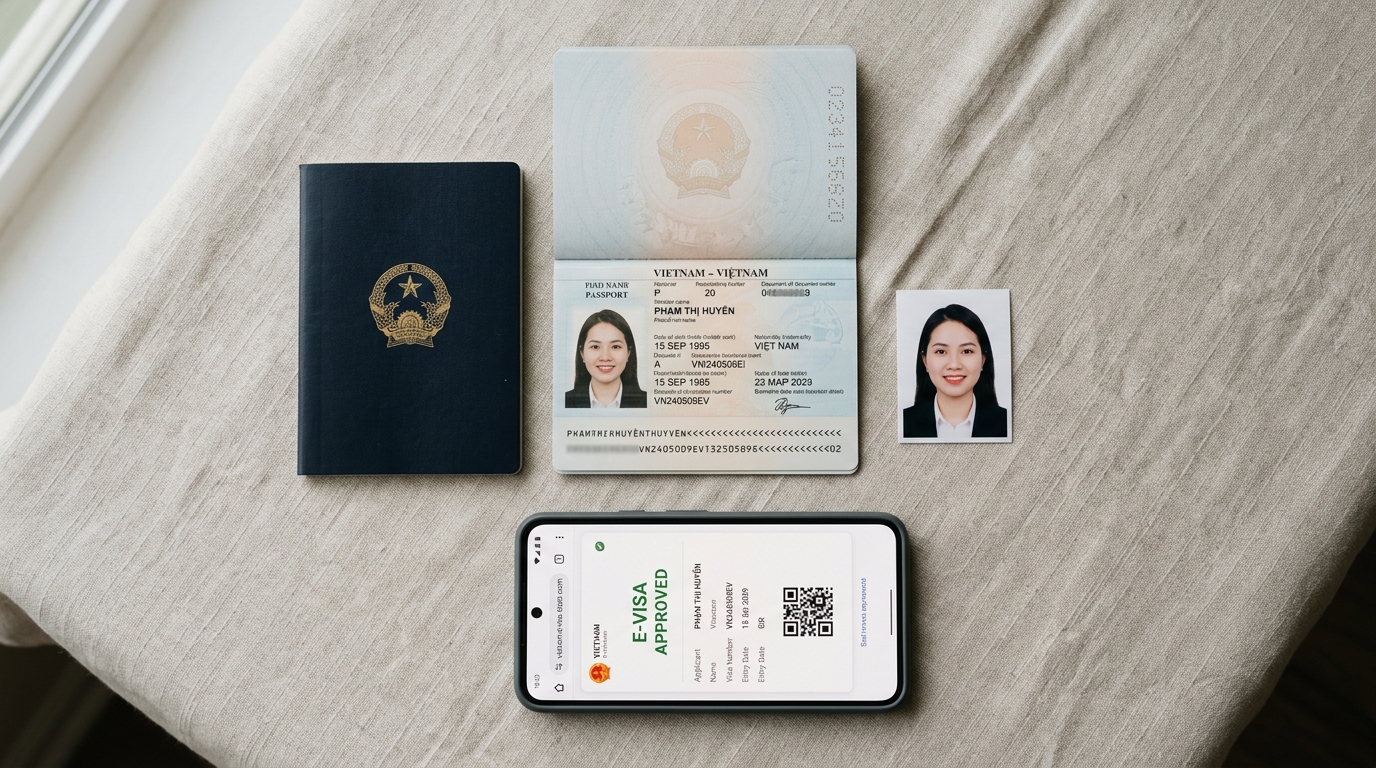
The core Vietnam e-visa requirements 2026 are simple to list but easy to get wrong: a passport valid for at least six months with two blank pages, a clean digital passport-style photo, a clear scan of your passport bio page, your exact travel dates, and an eligible port of entry. Miss any detail and the approval is delayed or refused — and when you fly in a few days, a refusal is the outcome you can least afford. This guide breaks down every requirement, the exact photo and data-entry specs that trigger most rejections, and how to pre-empt them.
Everything below reflects the rules in force in mid-2026, including the e-visa now being accepted across Vietnam’s expanded list of international gates and the new mandatory Digital Arrival Card. Where a figure changes often or varies by provider, we say so rather than guess — verify the live specifics on the official portal before you pay.
Vietnam e-visa requirements 2026: the complete checklist
Vietnam’s e-visa is open to citizens of all countries. It comes as single or multiple entry, is valid for up to 90 days, and since late 2025 is accepted at 83 international ports of entry — airports, land border gates and seaports. To apply, you need every item below ready and consistent with your passport.
- A valid passport — at least 6 months of validity beyond your arrival date and a minimum of two blank pages.
- A digital portrait photo — recent, plain white background, no glasses, no hat, neutral expression.
- A scan of your passport bio-data page — the full page, corners included, with the machine-readable ICAO line clearly visible.
- Your exact travel details — intended entry and exit dates, and an eligible port of entry.
- A temporary Vietnam address — your first hotel or accommodation.
- Payment — the government fee is US$25 for single entry and US$50 for multiple entry, and it is non-refundable.
The official government site is evisa.gov.vn. It has no expedite button and is effectively idle on weekends and public holidays, which is exactly why travellers on a tight clock turn to an agency service. If you want the full landscape of speed options first, see our complete 2026 guide to emergency and urgent Vietnam visas.
Passport validity and blank pages: the first thing an officer checks
Passport rules cause quiet, avoidable failures. Two conditions matter, and both are checked twice — by the system when it issues the visa, and by an immigration officer at the gate.
- Six months’ validity. Your passport must be valid for at least six months from the day you enter Vietnam, not the day you apply. If your passport expires this year, count carefully.
- Blank pages. You need at least two blank pages for entry and exit stamps. A full passport can get you turned away even with a perfect e-visa.
If you are renewing your passport before the trip, apply for the e-visa with the new passport number. An e-visa is electronically tied to one passport; a visa issued against an expired or soon-to-be-replaced document is worthless at the gate.
The photo and ICAO specs that cause the most rejections
Photos reject more Vietnam e-visa applications than anything else. The portal asks for two separate images — a portrait and a scan of your passport bio page — and they are judged against different standards. Uploading the same image twice, or swapping them, is one of the most common technical mistakes.
| Requirement | Portrait photo | Passport bio-data page scan |
|---|---|---|
| Format | JPG / JPEG | JPG / JPEG |
| Typical size guide | 4×6 cm, portrait style | Full bio page, all four corners visible |
| Background | Plain white, evenly lit, no shadows | N/A — but flat, no glare or curl |
| Face / content | Full face forward, neutral expression, no glasses, no hat | Name, number, dates and the full ICAO machine-readable line legible |
| Common failure | Glasses, glare, coloured background, cropped chin | Tilted image, cut-off corner hiding the ICAO line, blur or shadow |
Practical rules that keep the portrait clean: remove glasses entirely (even prescription lenses), take it against a genuinely white wall with soft front light, keep a plain expression, and make sure the top of your head and your chin are both inside the frame. For the passport scan, lay the page flat, fill the frame, and check that the two lines of << characters at the bottom — the ICAO line — are sharp and complete. If any corner is clipped, redo it.
Exact file-size caps and pixel dimensions shift from time to time, so confirm them on the portal at the moment you apply rather than relying on an older number. If you are staring at a rejection right now, our guide on what to do when your Vietnam e-visa is rejected and you fly soon walks through a fast, clean reapplication.
Data-entry details that quietly get urgent applications refused
After photos, the second big cause of trouble is typing. The e-visa is generated from exactly what you enter, and it must match your passport character for character. There is no human editor smoothing over your typos.
- Name order and spelling. Enter your name exactly as printed in your passport — correct fields, correct order, no reversed given and family names. A mismatched name can see you refused boarding at departure, before you even reach Vietnam.
- Passport number. One wrong character — a zero read as the letter O, a missed digit — can invalidate the visa. Check it twice against the document.
- Date of birth and nationality. These must match the passport, including the nationality shown, not where you live.
- Port of entry. Pick an eligible international gate from the list — the form asks for your intended gate of entry and exit. The rule the government states is about the list, not your pick: an e-visa “can only be used for entry and exit through border gates that are on the list approved by the Government of Viet Nam”, which since the December 2025 expansion means 83 gates. Treat that flexibility with care, though: UK government travel advice still tells travellers that an e-visa restricts them to the points they selected, and an airline agent or a border officer may take the stricter view. If your arrival point changes, keep it on the approved list, and check your own e-visa PDF to see whether a gate is printed on it.
- Dates. Your validity window starts on the entry date you declare, so make sure it covers your whole stay.
Because the fee is non-refundable, a rejected application costs you both the money and — more painfully — the time. That is the whole argument for getting the details right the first time when you are travelling soon.
What the e-visa does not cover: the 2026 Digital Arrival Card
A requirement many 2026 travellers miss: a valid e-visa is no longer the only thing you need to clear the gate at a growing list of airports. Since 15 April 2026, Vietnam has made a Digital Arrival Card mandatory, starting at Ho Chi Minh City’s Tan Son Nhat (SGN) and extended to Hanoi’s Noi Bai (HAN) from June 2026. Authorities plan to widen it to more international gateways — including Da Nang, Cam Ranh and Phu Quoc, plus selected land and sea border points — through the year, though not every gate requires it yet.
- It is a free online pre-arrival declaration on the official government portal — any site charging a fee for it is a reseller, not the government.
- You submit it within roughly 72 hours of your scheduled arrival; it generates a QR code that officers scan.
- It does not replace your visa. You still need a valid e-visa (or exemption) as well.
Because the rollout is expanding gate by gate, confirm whether your specific arrival airport requires it at the time you travel. Treat it as a second, separate box to tick alongside the visa itself.
Visa on arrival in 2026: why most urgent travellers can no longer use it
Travellers sometimes assume they can skip the paperwork and grab a visa at the airport. In 2026 that route is closed for most independent tourists. Visa on arrival now generally requires a pre-approval letter arranged in advance through a sponsoring agency, and it is reserved mainly for specific or urgent cases rather than ordinary leisure trips.
For nearly everyone flying in, the e-visa is the practical path — and when time is short, an urgent e-visa is almost always faster than trying to organise approval-letter visa on arrival. We compare the two head to head in e-visa or visa on arrival: which is faster in 2026.
How long it really takes — and where the urgent tiers fit
Standard government processing is officially about three working days. That count excludes the day you submit, and it ignores weekends and public holidays, so a Thursday-evening application can realistically mean the following week. During peak season and around Vietnam’s National Day holiday in early September, standard times stretch further still.
| Tier | Typical turnaround | Best for |
|---|---|---|
| Standard (government) | ~3 working days (often more in peak periods) | Trips 2+ weeks away |
| Urgent | ~1 working day | A few days’ notice |
| Rush | ~4–8 hours | Same or next day |
| Super urgent | ~1–2 hours | You are almost at the airport |
These faster tiers are offered by agency services at a premium over the US$25/US$50 government fee; exact prices and cut-off times vary by provider and by the time of day you apply, so confirm them directly before you commit. To see every legitimate acceleration method, read how to expedite a Vietnam visa in 2026, and if you have already submitted on the government site and are stuck waiting, see how to expedite a pending Vietnam e-visa. For a candid breakdown of what the very fastest options actually cost, our real all-in cost of a 1-hour and 2-hour Vietnam visa is worth two minutes.
Pre-empt a rejection: your final pre-submit checklist
Before you pay, run through this once more — it is the difference between a smooth approval and a scramble.
- Passport valid 6+ months from arrival, two blank pages confirmed.
- Name entered exactly as printed, correct fields, nothing reversed.
- Passport number checked twice against the document.
- Portrait: white background, no glasses, no hat, full face, JPG.
- Passport scan: flat, all corners in, ICAO line sharp and complete.
- Eligible port of entry selected, dates covering your whole stay.
- Single vs multiple entry chosen correctly — you cannot change it after issue.
- Digital Arrival Card planned for within 72 hours of arrival, if your gate requires it.
Get these right and there is very little left to go wrong. If you are short on time, or simply want a second set of eyes checking every field before it is submitted, you can start an urgent application and have your documents and data reviewed against these exact requirements before anything is filed. A few careful minutes now is the cheapest insurance for your trip.
Frequently asked questions
What are the passport requirements for a Vietnam e-visa in 2026?
Your passport must be valid for at least six months beyond your intended arrival date and have a minimum of two blank pages for entry and exit stamps. The name, number, date of birth and nationality on your application must match the passport exactly. If you are renewing your passport before the trip, apply using the new passport number, because the e-visa is tied electronically to one document.
Can I wear glasses in my Vietnam e-visa photo?
No. Glasses are not permitted in the Vietnam e-visa portrait, including prescription lenses, so remove them before the photo is taken. The image also needs a plain white background, even lighting with no glare or shadows, a neutral expression, and no hat or head covering unless worn for religious reasons. Photo problems are the single most common cause of rejection.
What happens if my name is entered in the wrong order on the e-visa?
The e-visa is generated from exactly what you type, so a reversed given and family name, a misspelling, or a wrong passport-number digit can invalidate it. Because your visa details must match your passport character for character, a mismatch can lead to being refused boarding at your departure airport, before you even reach Vietnam. Always check every field twice against the passport before paying.
Do I have to enter Vietnam at the exact port I selected on my e-visa?
The sources do not fully agree, so plan for the stricter reading. Vietnam’s own portal states the rule as a list rather than a single gate: an e-visa “can only be used for entry and exit through border gates that are on the list approved by the Government of Viet Nam”, and the application form asks for your intended gate of entry and exit. On that basis many agencies say you may arrive at any of the 83 eligible gates. UK government travel advice, however, still says an e-visa restricts you to the entry and exit points you selected. If your route changes, keep the new gate on the approved list, carry your booking, and look at your own e-visa PDF to see whether it names a gate – if it does, arriving somewhere else is a risk not worth taking on the day of the flight.
Do I still need a visa if I complete Vietnam’s Digital Arrival Card?
Yes. The Digital Arrival Card, mandatory at Ho Chi Minh City since April 2026 and expanding to Hanoi and other gates, is a free pre-arrival declaration that generates a QR code for immigration. It does not replace your visa. You still need a valid e-visa or an exemption to enter, and you complete the arrival card separately, typically within 72 hours of your scheduled arrival.
How long does a Vietnam e-visa take to process in 2026?
Standard government processing is about three working days, not counting the submission day, weekends or public holidays, so it can spill into the following week and stretch further in peak season. Agency services offer urgent tiers that typically run from around one working day down to rush and super-urgent options of a few hours, at a premium over the government fee. Confirm exact timing with the provider.