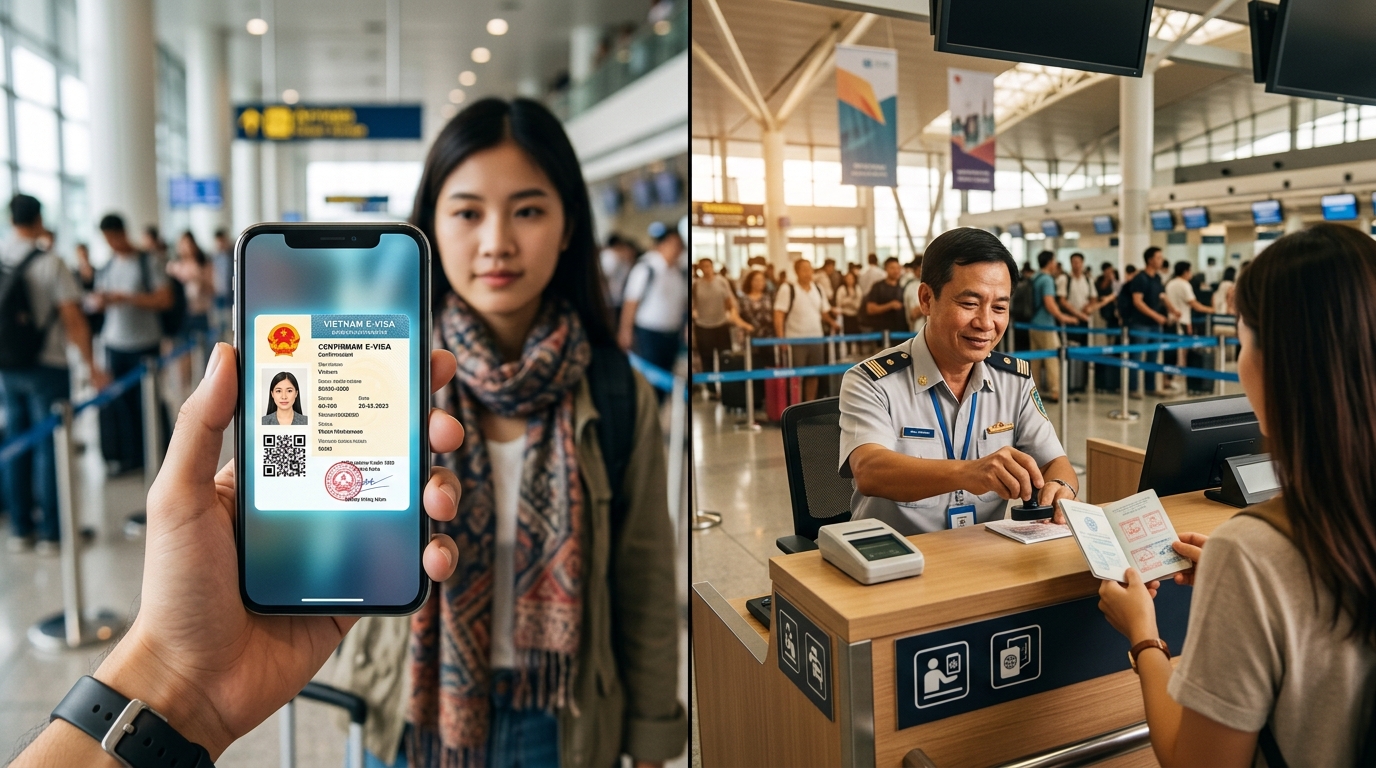
Short answer: in 2026, a super-urgent e-visa is almost always the faster route for independent travellers — and, just as importantly, the only legal one. Vietnam has restricted visa on arrival (VOA) so that most tourists can no longer simply land, queue, and get a stamp. So the real question — Vietnam e-visa or visa on arrival, which is faster — has flipped from the advice you’ll still see all over older blogs. If your flight is soon, an expedited e-visa processed in as little as a few hours during working days is now the dependable option.
This guide corrects the outdated “just get VOA, it’s quicker” myth, gives you a side-by-side comparison, and finishes with an hours-until-your-flight verdict so you know exactly what to do with the time you have left.
Why the old advice is wrong in 2026
For years, travel forums recommended visa on arrival as the fast, cheap way into Vietnam. That advice is now stale. Two changes reshaped the landscape:
- VOA is restricted for independent tourists. Visa on arrival is no longer a walk-up service. Travellers need a pre-approval letter arranged in advance through a sponsoring agency or organisation, it only works at airports (not land or sea borders), and it is mainly reserved for special or urgent cases rather than ordinary holidaymakers. For most independent tourists, VOA simply isn’t a practical option anymore.
- The e-visa became the default. Since August 2023 the Vietnam e-visa has been open to all nationalities and valid at every international port of entry — airports, land crossings, and seaports — with single or multiple entry and stays of up to 90 days. It is now the standard, government-preferred method of entry.
Put simply: the route that used to be “fastest” is now closed to most travellers, while the route that used to feel slow now has same-day and few-hour options through licensed agencies. That’s the freshness win most incumbent articles miss.
Vietnam e-visa or visa on arrival: which is faster — the comparison table
Here’s the honest 2026 comparison. Note that both options require paperwork before you fly; the difference is what happens at the airport and how fast the paperwork can move.
| Factor | Urgent e-visa | Visa on arrival (2026) |
|---|---|---|
| Who can use it | All nationalities (open to every passport) | Restricted — needs a sponsor/pre-approval letter; not for most independent tourists |
| Valid entry points | All international airports, land borders and seaports | International airports only — no land or sea crossings |
| Fastest realistic timeline | As little as a few hours in working hours (super-rush agency tier); standard ~3–5 working days | Approval letter typically a few working days (faster for urgent cases), plus a 15–45 min counter queue on arrival |
| Government fee | ~US$25 single entry / ~US$50 multiple (plus agency fee for urgent tiers) | Stamping fee (~US$25 single / ~US$50 multiple, cash) at the airport, plus the agency’s letter fee |
| At the airport | Straight to immigration/e-gates; nothing extra to buy or queue for | Separate “Landing Visa” counter, cash payment, passport photos, then immigration |
| Weekend processing | Government system effectively closed weekends; some agencies offer limited weekend workarounds | Some agencies still issue letters, but eligibility limits who can use it |
The takeaway: once you factor in eligibility, a VOA that “takes a few days for the letter and then a queue” is slower end-to-end than an urgent e-visa that lands in your inbox the same day — assuming you can even qualify for VOA in the first place, which most tourists can’t.
How fast can an urgent e-visa really be?
The official portal at evisa.gov.vn has one speed: standard, roughly 3–5 working days (longer in peak season), with no expedite button and no weekend processing. If you have a week or more before departure, apply there and pay only the government fee.
If you don’t have that luxury, licensed agencies submit through the same government system but prioritise your file and use their working relationship to accelerate it. Typical tiers you’ll see advertised include:
- ~1 working day — comfortable buffer, modest premium.
- ~4–8 hours — same-day travel handled within business hours.
- ~2 hours — genuine last-minute, still legal and traceable.
- ~1 hour — the fastest published tier, for true emergencies.
These timeframes are advertised ranges, not guarantees, and they depend heavily on applying during Vietnam business hours (roughly 08:00–16:00, Monday to Friday). Exact prices vary by provider and change often, so always confirm the current fee and realistic turnaround before you pay. For a deeper breakdown of what each speed genuinely costs all-in, see the real all-in cost of a 1-hour and 2-hour Vietnam visa, and for the full menu of acceleration methods read our guide on how to expedite a Vietnam visa in 2026.
One detail people miss when they’re cutting it fine: the e-visa application asks for an intended date of entry, and you can only enter Vietnam on or after that date. Put the correct date on the form — the day you actually plan to land — because a visa issued for tomorrow won’t get you through immigration today. If your plans slip, that field, not the processing speed, is often what trips travellers up.
The weekend trap
Here’s the nuance most guides skip. Because the immigration system generally doesn’t process e-visas on Saturdays and Sundays, a “2-hour” tier requested at 9pm Saturday may not actually complete until Monday. Agencies advertise weekend solutions, but treat weekend turnaround as best-effort. If your flight is on a Sunday or Monday morning, start on Friday if you possibly can. If you’ve already submitted through the government portal and it’s stuck, our guide on how to expedite a pending Vietnam e-visa explains what can — and can’t — be done to speed it up.
The hours-until-your-flight verdict
Match your situation to the clock. This assumes you’re an ordinary tourist who cannot access sponsored VOA.
- More than 5 days out: Apply on the official portal (evisa.gov.vn) at the government fee. No premium needed. Double-check every field against your passport — errors cause rejections, and a rejection this close is avoidable stress.
- 2–5 days out: Use an agency’s ~1-working-day tier. It buys margin against a data-entry hiccup or a weekend falling in the middle of your window.
- Same day / under 24 hours (a weekday): Go straight to a super-urgent e-visa (4–8 hour, 2-hour, or 1-hour tier). Apply the moment you decide; every hour matters, and business hours in Vietnam are what count.
- Hours before a weekend flight: This is the hardest case. Contact a 24/7 provider immediately, confirm in writing whether a genuine weekend turnaround is possible for your nationality and departure airport, and have a backup plan (a later flight) ready.
- You think you qualify for sponsored VOA: Only pursue VOA if an eligible sponsor is arranging your approval letter and you’re flying into an international airport. Otherwise, don’t count on it — most travellers who assume they can “just get it on arrival” are turned away at check-in.
Whatever your nationality, the logic above holds. US passport holders can find nationality-specific timing and document notes in our guide to an urgent Vietnam visa for US citizens, and every traveller should skim the urgent Vietnam e-visa requirements for 2026 before applying so a small mistake doesn’t cost you a day.
Don’t forget the digital arrival card
A separate 2026 change catches travellers off guard: Vietnam’s mandatory digital arrival card, a free pre-arrival declaration submitted online (at prearrival.immigration.gov.vn) that generates a QR code for the border. It became mandatory at Tan Son Nhat (SGN) on 15 April 2026, reached Phu Quoc and Noi Bai (Hanoi) from June 2026, and now also covers Da Nang, Cam Ranh, the Dong Dang land gate and a growing list of seaports. You can only submit it within 72 hours of your arrival, so add it to your pre-flight checklist rather than trying to do it too early.
This is not a visa and does not replace one. You still need your e-visa; the arrival card is an additional, quick step (a few minutes) that applies regardless of visa type. Because the scope keeps expanding, complete it for any 2026 arrival and verify whether your specific port requires it before you fly.
What to do if your e-visa is rejected
An urgent e-visa is fast, but a rejected application resets the clock — usually over a small error like a mismatched name, a poor photo, or a passport validity issue. If that happens close to departure, don’t panic and don’t simply resubmit the same file. Our step-by-step on what to do when your Vietnam e-visa is rejected and you fly soon walks through reapplying cleanly and fast.
Bottom line
In 2026, the fastest legal way into Vietnam for nearly every independent traveller is an expedited e-visa — not visa on arrival, which is now restricted, airport-only, and off-limits to most tourists. During weekday business hours, an urgent tier can deliver in hours; over a weekend, give yourself as much runway as possible. Ignore the old “just do VOA” advice and plan around the e-visa. For the complete emergency playbook covering every scenario, timeline and contingency, read our pillar guide to an emergency and urgent Vietnam visa in 2026.
Short on time and not sure which tier you need? Start an urgent Vietnam e-visa application and tell us your flight time — we’ll point you to the fastest legal option for your date and nationality, and flag anything worth double-checking before you pay.
Frequently asked questions
Is visa on arrival still available for tourists in Vietnam in 2026?
For most independent tourists, no. In 2026 visa on arrival is restricted: it requires a pre-approval letter arranged in advance through a sponsor or agency, works only at international airports (not land or sea borders), and is mainly reserved for special or urgent cases. Ordinary holidaymakers are directed to the e-visa instead, so you cannot rely on simply landing and getting a stamp.
Which is faster in 2026, a Vietnam e-visa or visa on arrival?
For nearly every independent traveller, the e-visa is faster end-to-end. A super-urgent e-visa can be issued in as little as a few hours during Vietnam business hours, and you walk straight to immigration on arrival. Visa on arrival needs an approval letter (typically a few working days) plus a counter queue at the airport, and most tourists can’t legally use it at all.
How fast can I get an urgent Vietnam e-visa?
The official government portal offers only standard processing of about 3-5 working days, with no expedite option and no weekend processing. Licensed agencies advertise faster tiers, commonly around 1 working day, 4-8 hours, 2 hours, or even 1 hour, at a premium. These are advertised ranges rather than guarantees and depend on applying during Vietnam business hours. Always confirm current pricing and realistic turnaround with the provider.
Can I get an urgent Vietnam e-visa on a weekend?
It’s difficult. The immigration system generally does not process e-visas on Saturdays and Sundays, so an urgent tier requested over a weekend may not complete until Monday. Some agencies advertise weekend workarounds, but treat them as best-effort. If your flight is on a weekend or Monday morning, start on Friday if you possibly can and keep a backup plan.
Do I need the Vietnam digital arrival card as well as a visa?
Yes, if you’re entering through a port that requires it. The digital arrival card is a free online pre-arrival declaration that became mandatory at Tan Son Nhat (Ho Chi Minh City) on 15 April 2026 and has since expanded to Phu Quoc, Noi Bai (Hanoi), Da Nang, Cam Ranh, the Dong Dang land gate and seaports. It is not a visa and does not replace one, it’s a short additional step (submitted within 72 hours of arrival) that applies regardless of visa type. Verify whether your arrival port requires it before you fly.
Is visa on arrival cheaper than an e-visa?
The headline numbers can look cheaper for VOA (a lower agency letter fee plus a cash stamping fee), but for most tourists that comparison is moot because they can’t legally use VOA. A standard e-visa costs about US$25 single entry or US$50 multiple entry at the government fee, with urgent tiers adding an agency premium. Confirm current figures with your provider before paying.