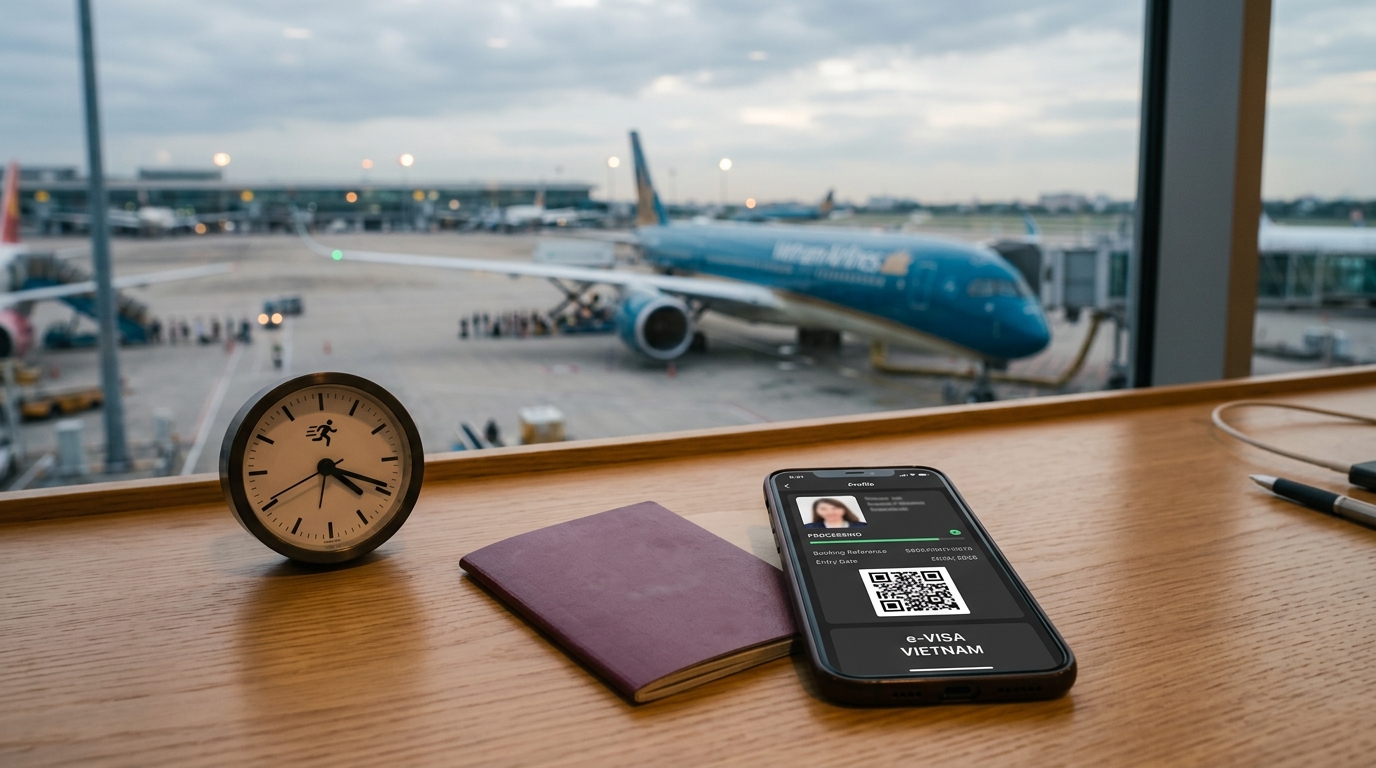
To expedite a Vietnam visa in 2026, apply through a licensed visa agency that offers urgent e-visa tiers — realistically anywhere from about one working day down to one hour of processing, for a premium on top of the standard US$25 government fee. The official portal at evisa.gov.vn has no rush button and effectively pauses over weekends, so a specialist agency is the only reliable way to speed up approval when your flight is close.
That is the short answer. The rest of this guide is what actually saves stressed travellers: which tier matches your real deadline, what genuinely speeds an application up (and what quietly slows it down), and how to read the clock in Vietnam time so you don’t pay for “1-hour” processing that lands after check-in has closed.
Can you expedite a Vietnam visa on the government website?
No. The official e-visa system at evisa.gov.vn is a single-speed service. You pay roughly US$25 for a single-entry e-visa or about US$50 for multiple entry, and the stated processing time is around three working days — often stretching to five in peak season because of record tourist volumes and payment-gateway delays.
Two things matter here for anyone in a hurry:
- There is no paid express option. The government portal does not sell faster processing at any price.
- Weekends and public holidays don’t count. Immigration officers process during Vietnamese business hours, Monday to Friday, so a Friday-night submission may not move until Monday. Around Tet (Lunar New Year), gaps can be longer.
So when people search for how to expedite a Vietnam visa, what they really need is an agency that has staff working Vietnam business hours (and often weekends), submits a clean application, and prioritises it in the queue. Speed comes from process and priority — not from a secret setting on the official site.
The four fast-track tiers, and what they realistically deliver
Agencies package urgency into tiers. Names vary by provider (“urgent”, “super urgent”, “emergency”, “rush”), but the underlying speeds cluster into four bands. Treat every time below as a working-hours estimate, not a countdown that runs through the night, and always confirm the exact window with your provider before you pay.
| Tier | Typical processing | Best for | What to know |
|---|---|---|---|
| Standard e-visa (government) | ~3 working days (up to 5 in peak) | Trips 1+ week away | Cheapest; no weekend movement |
| Urgent / next working day | ~1 working day | Flights in 2–3 days | Modest premium; good safety margin |
| Same-day / express | ~4–8 working hours | Flights inside 24 hours | Submit early in Vietnam’s day |
| Super-urgent | ~2 working hours | Same-day departures | Higher premium; timing is tight |
| Emergency | ~1 working hour | Airport / last-minute crises | Highest cost; verify feasibility first |
Fees rise steeply as the clock shrinks. The urgent and same-day tiers are affordable for most people; the 2-hour and 1-hour tiers carry a real premium because someone is working your file by hand and pushing it to the front of the line. We keep exact numbers out of this guide on purpose — they move around and vary by nationality — but you can see how the all-in maths works in our breakdown of the real cost of a 1-hour and 2-hour Vietnam visa. Always confirm the current price and cut-off before paying.
Why “1 hour” rarely means 60 minutes on your clock
Three factors sit between you and your visa email:
- Vietnam business hours (ICT, UTC+7). The fastest tiers depend on immigration officers actively processing. A 1-hour tier bought at 2am Hanoi time may not truly start until the office reopens.
- Payment confirmation. The clock usually starts when your payment clears and your documents are complete — not when you hit submit.
- Your airline’s cut-off. Check-in and boarding-gate deadlines are the real finish line. A visa that arrives 20 minutes before departure is often too late to be useful.
Expedite Vietnam Visa: choosing a tier by hours until your flight
The single most useful thing you can do is match the tier to your actual deadline. Use this as a rule of thumb, then build in a buffer:
| Time until flight | Recommended tier | Notes |
|---|---|---|
| 5+ days | Standard, or urgent for peace of mind | You have room even if peak-season delays hit |
| 48–72 hours | Urgent (next working day) | Comfortable buffer; low stress |
| 12–24 hours | Same-day (4–8 hours) | Submit as early in Vietnam’s day as possible |
| 3–6 hours | Super-urgent (2 hours) | Only during Vietnam business hours; confirm cut-off |
| Under 3 hours | Emergency (1 hour) | Message the provider first to confirm it’s even possible |
Two extra rules save people from wasting money:
- If it’s a weekend or holiday, shift up a tier. What would be “same-day” on a Tuesday may need the super-urgent path on a Sunday because the standard queue isn’t moving.
- If you’re already at the airport, don’t buy blind. Contact the provider, share your exact departure time, and let them tell you honestly whether they can beat your gate cut-off. A refund on an impossible request beats a visa that lands too late.
If your situation is genuinely last-minute — a missed connection, a same-night departure, a family emergency — our complete 2026 guide to emergency and urgent Vietnam visas walks through the airport-desk scenarios, including what to do when standard processing isn’t an option.
What actually speeds up approval
Paying for a faster tier buys queue priority, not forgiveness for a messy application — and a file that bounces back for corrections can blow past your flight whatever tier you bought. These details do the quiet work of getting you approved on the first pass:
- A clean passport scan. The full information page, flat, in focus, no glare, all four corners visible. This is the number-one cause of avoidable delays.
- A compliant photo. Recent, front-facing, plain white background, no glasses, no hat, neutral expression. Selfies and cropped snapshots get rejected.
- Details that match your passport exactly. Name spelling, date of birth, and passport number must line up with the machine-readable line. One transposed digit can stall everything.
- At least six months of passport validity beyond your intended entry date, with blank pages available.
- The correct port of entry. The e-visa is valid at Vietnam’s 83 designated international air, land, and sea checkpoints, but you still list your intended first gateway — match it to your ticket.
- Applying during Vietnam business hours and paying immediately so the processing clock starts without a gap.
- Fast replies to the agency. If they ask a clarifying question, answer within minutes, not hours.
What slows it down — or triggers a rejection
- Blurry, cropped, or partially covered passport images
- Name, date-of-birth, or passport-number mismatches and typos
- A passport with under six months of validity
- Weekend or public-holiday submissions on a standard tier
- A prior overstay or other immigration flag
- Duplicate or conflicting applications submitted in parallel
- Blank or inconsistent occupation, address, or entry-date fields
Getting the fundamentals right the first time is the real accelerator. Our checklist of urgent Vietnam e-visa requirements for 2026 lays out exactly what to prepare before you start, so nothing bounces back.
Common expedite scenarios
You already submitted on the government portal and it’s crawling
This is the hardest case, because you generally cannot accelerate a submission that’s already sitting inside the official system — there’s no upgrade path once it’s lodged. Your realistic options depend on timing and whether the existing application can be worked around. We cover the moves that actually help in how to expedite a pending Vietnam e-visa you already submitted.
Your e-visa was rejected and you fly soon
A rejection near departure feels like a wall, but it’s often fixable fast if you understand why it happened — usually a photo or data issue rather than an eligibility problem. Read Vietnam e-visa rejected and you fly soon: reapply fast for the reapplication path that loses the least time.
You’re wondering whether visa on arrival is faster
In 2026 this is mostly a dead end for independent tourists. Visa on arrival (VOA) is now restricted: it requires a pre-approval letter arranged in advance, applies to air arrivals only, and is aimed at specific cases rather than walk-in travellers. For nearly everyone, the e-visa is both faster and simpler. We compare them head to head in e-visa or visa on arrival: which is faster in 2026.
Don’t forget the digital arrival card
Expediting your visa is only half of a 2026 entry. Vietnam has rolled out a mandatory digital arrival card (pre-arrival declaration) that most foreign travellers must complete before landing. It began at Ho Chi Minh City’s Tan Son Nhat (SGN) in April 2026 and has since expanded to Noi Bai (HAN), Da Nang (DAD), Cam Ranh (CXR), Phu Quoc (PQC) and other major airports.
- It’s a free government declaration, submitted online, that generates a QR code immigration scans on arrival.
- You can submit it within roughly 72 hours before arrival, and it takes only a few minutes once your details are ready.
- It does not replace your visa — you still need the e-visa itself. The two are separate steps.
Vietnam also introduced a separate online health declaration from 1 July 2026, reportedly to be submitted within about seven days before arrival — check whether it applies to you on the official portal. Verify the current portals and the airports in scope before you travel, as coverage is still expanding through 2026. Don’t let a five-minute form become the thing that holds up an entry you paid a premium to speed up.
A quick word on choosing a provider
When the clock is tight, pick a provider that will talk to you before you pay. The good signs are simple: a real human who confirms whether your deadline is achievable, a clear statement of what the tier includes, honest handling of weekends and time zones, and no guarantees that sound too absolute — no legitimate agency can promise the immigration department’s decision. Nationality affects both timing and cost, and US travellers can see the specifics in our guide to urgent Vietnam visas for US citizens.
The bottom line
You can expedite a Vietnam visa far faster than the official three-day standard — down to a working hour in a genuine emergency — but only through an agency, only during Vietnam’s business hours, and only if your paperwork is clean. Match the tier to the hours you actually have, add a buffer for payment and your airline cut-off, and get the passport scan and photo right the first time. Do that, and even a same-day departure is usually survivable.
If your flight is close and you’d rather have a specialist handle the queue for you, you can start an urgent Vietnam visa application and have your exact deadline reviewed before you commit — so you know your real options before the clock runs out.
Frequently asked questions
Can you expedite a Vietnam visa on the official government website?
No. The government portal at evisa.gov.vn offers only one processing speed, around three working days, with no paid express option, and it does not move applications forward on weekends or public holidays. To go faster you need a licensed agency that works Vietnam business hours and prioritises your file.
What is the fastest you can get a Vietnam visa?
The quickest agency tiers advertise roughly one working hour, with two-hour and same-day options just above. In practice, “one hour” only applies during Vietnam business hours and starts once your payment clears and documents are complete. Always factor in your airline’s check-in and boarding cut-off, which is the true deadline.
How much does it cost to expedite a Vietnam visa?
You pay the standard government fee (about US$25 single entry or US$50 multiple entry) plus an agency premium that grows as the processing window shrinks. Next-working-day and same-day tiers are modest; the two-hour and one-hour emergency tiers cost significantly more. Confirm the exact figure for your nationality and tier with the provider before paying.
Does paying for faster processing improve my chances of approval?
No. A faster tier buys queue priority, not a better decision. Approval still depends on a clean passport scan, a compliant photo, and details that match your passport exactly. A rushed but sloppy application can be sent back for corrections and end up slower than a careful standard one.
Can I still use visa on arrival to speed things up in 2026?
For most independent tourists, no. Visa on arrival is now restricted, requires a pre-approval letter arranged in advance, applies only to air arrivals, and is aimed at specific cases. The e-visa is usually both faster and simpler, so it’s the better route for a last-minute trip.
Can I expedite an e-visa I already submitted on the government portal?
Generally not directly — once an application is inside the official system there’s no upgrade to a faster lane. Depending on timing, your best move may be a fresh agency-managed application or a targeted correction. The practical options are covered in our guide to expediting a pending Vietnam e-visa.
Frequently asked questions
Can you expedite a Vietnam visa on the official government website?
No. The government portal at evisa.gov.vn offers only one processing speed, around three working days, with no paid express option, and it does not move applications forward on weekends or public holidays. To go faster you need a licensed agency that works Vietnam business hours and prioritises your file.
What is the fastest you can get a Vietnam visa?
The quickest agency tiers advertise roughly one working hour, with two-hour and same-day options just above. In practice, one hour only applies during Vietnam business hours and starts once your payment clears and documents are complete. Always factor in your airline’s check-in and boarding cut-off, which is the true deadline.
How much does it cost to expedite a Vietnam visa?
You pay the standard government fee (about US$25 single entry or US$50 multiple entry) plus an agency premium that grows as the processing window shrinks. Next-working-day and same-day tiers are modest; the two-hour and one-hour emergency tiers cost significantly more. Confirm the exact figure for your nationality and tier with the provider before paying.
Does paying for faster processing improve my chances of approval?
No. A faster tier buys queue priority, not a better decision. Approval still depends on a clean passport scan, a compliant photo, and details that match your passport exactly. A rushed but sloppy application can be sent back for corrections and end up slower than a careful standard one.
Can I still use visa on arrival to speed things up in 2026?
For most independent tourists, no. Visa on arrival is now restricted, requires a pre-approval letter arranged in advance, applies only to air arrivals, and is aimed at specific cases. The e-visa is usually both faster and simpler, so it’s the better route for a last-minute trip.
Can I expedite an e-visa I already submitted on the government portal?
Generally not directly — once an application is inside the official system there’s no upgrade to a faster lane. Depending on timing, your best move may be a fresh agency-managed application or a targeted correction. The practical options are covered in our guide to expediting a pending Vietnam e-visa.