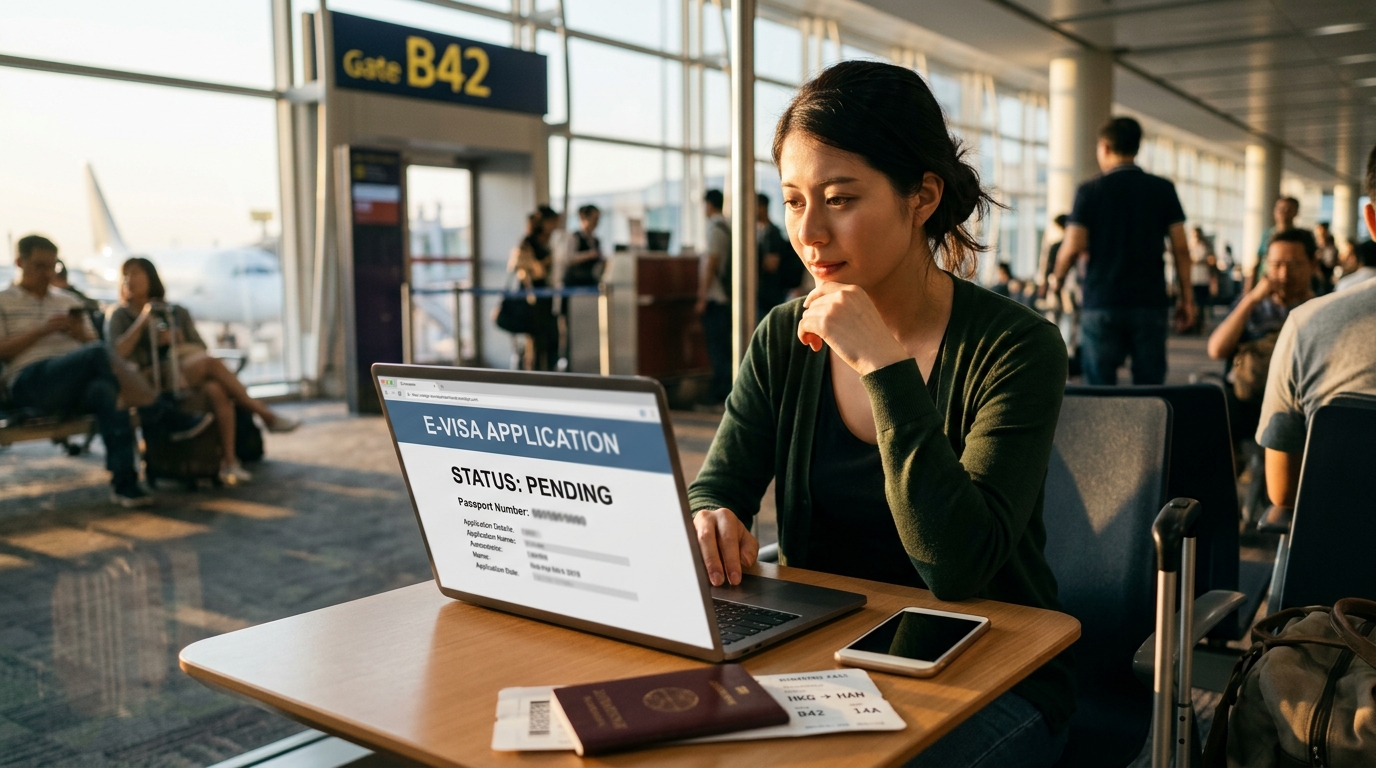
Short answer: There is no “rush” or “expedite” button on the official Vietnam e-visa portal (evisa.gov.vn), so you cannot directly expedite a pending Vietnam e-visa once it has been submitted. If your application is stuck “in processing” and your flight is close, you realistically have three moves: wait it out while actively watching for correction requests, ask a licensed agency to push or re-lodge your case, or file a fresh urgent e-visa application through a fast-track service that turns around in hours. This guide walks through each option and gives you an hour-by-hour decision based on time until departure.
Take a breath first. A stuck e-visa is one of the most common travel scares, and in the large majority of cases it is still solvable right up to the day of the flight. What matters now is choosing the right move for the time you actually have left, and not making things worse by panicking.
Why your Vietnam e-visa is stuck “in processing”
The standard government processing time is about three working days, but in 2026 many travellers report longer waits — often four to seven working days, and sometimes longer around peak season or public holidays. “In processing” simply means your application is sitting in the immigration queue and has not been decided yet. Common reasons it drags:
- Weekends and holidays. The portal effectively pauses on Saturdays, Sundays and Vietnamese public holidays. An application filed on Friday night barely moves before Monday.
- A photo or passport-scan issue. A glare, a cropped edge, or a face-photo that fails the check can silently hold your file.
- A data mismatch. A name spelled differently from the passport, a wrong date of birth, or a passport number or expiry date that doesn’t match your document.
- A pending correction request. Immigration may have flagged your file for a fix — and, crucially, they usually do not email you about it. You have to check the portal yourself.
- System load. High-volume periods create backlogs that push every application back.
Before you spend a cent on any rescue option, log in and confirm which of these you are dealing with. The fix is often free.
The honest truth: you cannot expedite a pending Vietnam e-visa on the government portal
This is the single most important thing to understand. The official system at evisa.gov.vn has no paid priority lane, no VIP queue, and no way for you — or anyone — to reach into your submitted file and speed it up. Any website promising to “hack” the government queue on your existing code is overselling what is actually possible.
So what do the “speed up your existing application” services actually do? In practice, a licensed agency with immigration contacts can sometimes request a faster review of a file that is genuinely just sitting in the queue. That can help — but it is a request, not a guarantee, and it does nothing if your file is held for a photo or data problem. The outcome you can actually rely on inside a fixed deadline is usually a fresh urgent application processed through the agency’s own fast-track channel. Any provider should be transparent about which of these they are doing before you pay, so ask them directly and verify.
The 3 real options when your e-visa is stuck
Option 1 — Wait it out (and do it properly)
If you have four or more days until your flight and your status page shows no correction request, waiting is legitimate and free. “Properly” means: check your status once or twice a day, keep your phone and email reachable, and be ready to respond to a correction request the same day it appears. Do not just refresh and hope — most delays that clear on their own do so within the normal window.
Option 2 — Have an agency push or re-lodge your case
A reputable agency can review your submitted details, tell you honestly whether your file is simply queued or is stuck on a fixable error, and either request a priority review or re-lodge a clean application on your behalf. This is the middle path: faster and more informed than waiting, without you starting from scratch alone. Confirm exactly what the fee covers and whether it is a queue-push or a resubmission.
Option 3 — File a fresh urgent e-visa application (the reliable rescue)
When the clock is genuinely tight, the surest fix is a brand-new e-visa submitted through an urgent fast-track service. In an urgent or genuine-error situation you are allowed to lodge a fresh e-visa while the original is still pending, and if both are eventually approved you simply travel on whichever is valid. One important caveat: immigration does not want two active e-visas on the same passport, and careless duplicate submissions can get both flagged — so this works only as a single, clean application, never as portal spam. A fresh urgent application also sidesteps whatever was quietly holding your first one. Fast-track tiers typically run from next working day down to same-day windows of roughly 4–8 hours, 2 hours, and even 1 hour, at a premium over the government fee.
One caution: never file a second application from inside Vietnam, and don’t pile on duplicate submissions on the government portal yourself — identical applications can jam your records or get them suspended. A single clean urgent application through a fast-track provider is the controlled version of this move.
| Option | Best when | Realistic speed | Relative cost | Main risk |
|---|---|---|---|---|
| Wait it out | 4+ days to flight, no correction flagged | Normal queue (often 4–7+ working days) | Free (government fee only) | Queue keeps slipping; you run out of runway |
| Agency push / re-lodge | 2–4 days, unsure why it’s stuck | Hours to ~1–2 days | Government fee + service fee | A “push” is a request, not a guarantee |
| Fresh urgent e-visa | Under 2 days, or file held on an error | ~1 hour to next working day | Government fee + urgent premium | You pay a second government fee |
For a full breakdown of every fast lane and how the tiers compare, see our guide to every fast-track option to expedite a Vietnam visa, and the honest numbers in the real all-in cost of a 1-hour and 2-hour visa.
Hour-by-hour: what to do based on time until your flight
Match your situation to the row below. Vietnamese immigration works on Vietnam time (UTC+7), so “working hours” means their business hours, not yours — and if a weekend or Vietnamese public holiday falls between now and departure, treat yourself as having far less usable time than the calendar shows.
| Time until flight | Recommended move |
|---|---|
| More than 4 days | Wait it out. Check status daily. Do nothing drastic — most files clear inside this window. |
| 2–4 days | Check for a correction request now. If none, start monitoring closely; if a weekend intervenes, line up an agency push or a next-day urgent application as a safety net. |
| 24–48 hours | Stop waiting passively. File a fresh same-day or next-day urgent e-visa, or have an agency re-lodge. Have passport scan and photo ready. |
| 6–24 hours | Go straight to the fastest urgent tier (2-hour to same-day). Message the provider directly with your flight time and full details. |
| Under 6 hours | Contact an urgent provider immediately for a 1–2 hour tier and ask what is genuinely achievable before boarding. Have everything ready to submit in minutes. |
If your original application was actually rejected rather than just slow, the playbook is different — read what to do when your e-visa is rejected and you fly soon before you reapply, so you don’t repeat the mistake that got it refused.
Before you pay for anything: check your status the right way
Two minutes here can save you a fee. Go to the official search page, enter your registration code (the code looks like E220731INDZ558244139), your email and date of birth, and read the result carefully:
- “Processing” — your file is queued and no action is requested. Waiting or an agency push are your options.
- A request for correction or additional documents — act today. No speed-up service can override this; you (or your agency) must supply the fix first. Once you respond, the clock effectively restarts, so faster is better.
- Approved — download and print the PDF. You’re done with the visa itself (but keep reading about the arrival card below).
Remember that Vietnamese immigration typically will not email you when something is wrong — the portal is the source of truth, so check it yourself rather than waiting for a message that may never come. If you have waited well beyond the normal window with no movement, the portal also has an official support/contact form you can use.
Don’t forget the 2026 digital arrival card
New in 2026: a mandatory, free digital arrival card / pre-arrival declaration is now required at a growing list of entry points, submitted through the government’s official pre-arrival portal. It launched at Ho Chi Minh City (Tan Son Nhat, SGN) in April 2026 and has since expanded to airports including Hanoi (HAN), Phu Quoc (PQC), Da Nang (DAD) and Cam Ranh (CXR), plus the Dong Dang land border and a range of seaports. It is separate from your visa: even with an approved e-visa, you typically must submit this declaration within the 72-hour window before arrival to clear immigration smoothly. Check the current list of covered ports for your route and don’t leave it to the airport. Scope is still expanding through 2026, so verify what applies on your arrival date.
What about visa on arrival as a backup?
For most independent tourists in 2026, visa on arrival (VOA) is not the quick escape hatch it once was. The rules now steer regular travellers to the e-visa, and VOA is largely reserved for specific cases — and it still requires a pre-approval letter arranged in advance through an agency, so it is not a walk-up option at the airport. It also only covers arrival by air. If you’re weighing the two, our comparison of e-visa vs visa on arrival and which is faster in 2026 lays out who can still use VOA and when it actually saves time. For most stuck applicants, a fresh urgent e-visa is faster and cleaner than trying to pivot to VOA.
US travellers can find nationality-specific timing and document notes in our guide to an urgent Vietnam visa for US citizens, and the full toolkit lives in our complete 2026 guide to emergency and urgent Vietnam visas.
Quick recap
- You cannot expedite a pending Vietnam e-visa inside the government portal — there is no priority button.
- First, check your status for a correction request; fixing that is free and often the whole problem.
- With time to spare, wait and monitor. With little time, a fresh urgent e-visa is the most reliable rescue.
- Agency “push” services can request a faster review but cannot guarantee it; a clean urgent resubmission is what you can actually rely on.
- Remember the 2026 digital arrival card — it’s separate from your visa and increasingly mandatory.
If your flight is close and your application is still sitting in “processing,” the safest next step is to start a clean urgent e-visa application now, while you still have runway. Have your passport scan, a compliant photo, and your flight details ready, and choose the fastest tier your timeline needs — you can begin an urgent application with us in a few minutes, and we’ll tell you honestly what’s achievable before you board.
Frequently asked questions
How long does a Vietnam e-visa take to process in 2026?
Officially about three working days, but in 2026 many applicants report four to seven working days, and sometimes longer around peak season or public holidays. Weekends and Vietnamese public holidays don’t count as processing days, so a Friday-night submission barely moves before Monday. If yours is past the normal window with no update, check the portal for a correction request before assuming it’s just slow.
Can I pay to speed up my pending Vietnam e-visa?
Not on the government portal itself — there is no paid priority lane at evisa.gov.vn. A licensed agency can sometimes request a faster review of a file that’s genuinely just queued, but that’s a request, not a guarantee. The outcome you can rely on inside a tight deadline is usually a fresh urgent e-visa application processed through a fast-track channel. Ask any provider to state clearly which they’re doing.
Why is my Vietnam e-visa stuck in processing?
Usually one of: a weekend or holiday pause, a photo or passport-scan that failed the check, a data mismatch (name spelling, date of birth, passport number), a pending correction request you haven’t seen, or general system backlog. Because immigration typically won’t email you, log in to the status page to find out which one applies — the fix for a flagged file is often free.
What happens if my flight leaves before my e-visa is approved?
You generally cannot board a flight to Vietnam without an approved e-visa (or another valid entry document), and airlines can deny boarding. That’s why, once you’re inside about 48 hours, the safer move is a fresh urgent e-visa rather than continuing to wait on the original. If you truly can’t get approved in time, rebooking may be cheaper than a denied boarding.
Can I apply for a second Vietnam e-visa while the first is still pending?
You can in an urgent or genuine-error situation — you’re allowed to lodge a fresh e-visa while the first is still processing, and if both approve you simply travel on whichever is valid. But immigration doesn’t permit two active e-visas on one passport, and careless duplicate filings can get both suspended. So do it as a single, clean application — ideally through an agency that manages the timing — never as repeated portal submissions, and never from inside Vietnam.
Does the Vietnam e-visa portal process applications on weekends?
Effectively no. The official system pauses on Saturdays, Sundays and Vietnamese public holidays, so applications filed for a weekend see little to no movement until the next working day. When you’re counting time until your flight, count working hours — not calendar days — and treat an intervening weekend as lost runway.