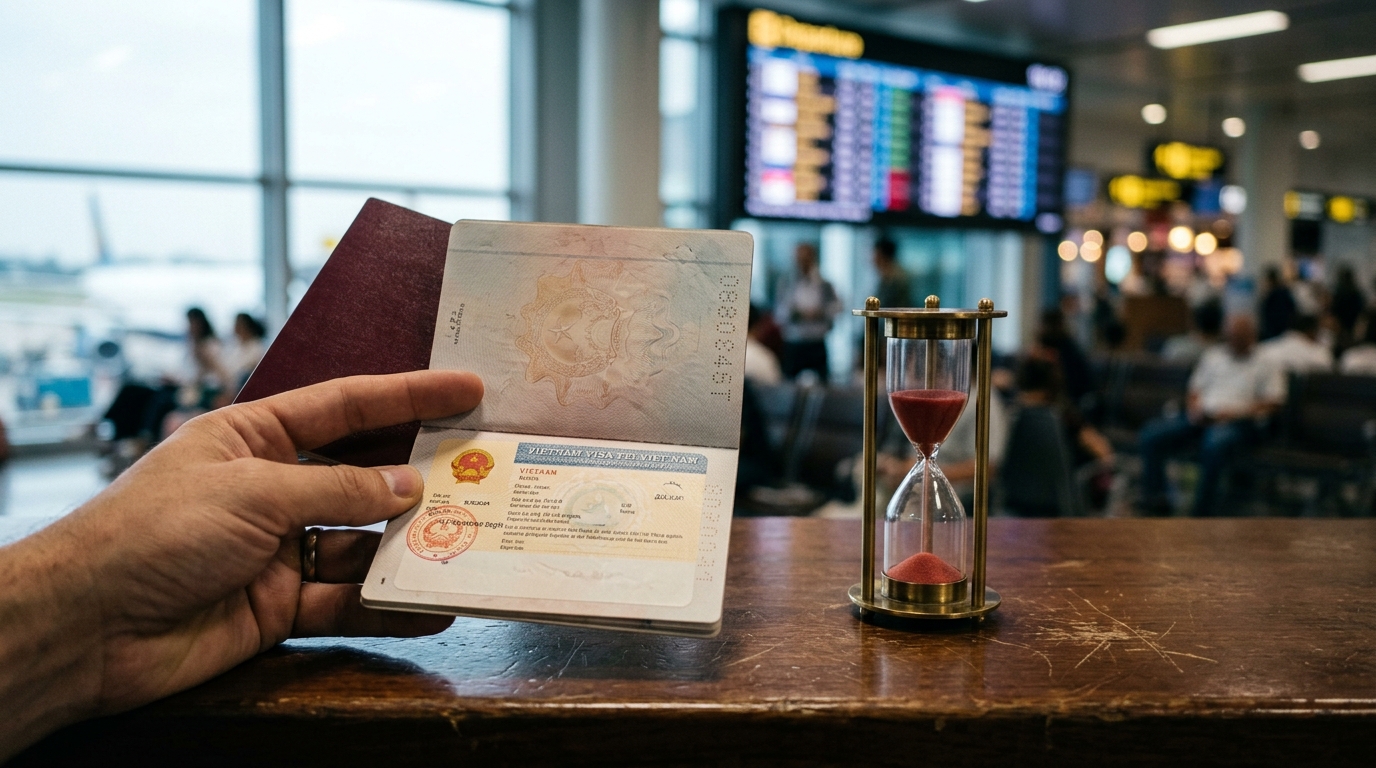
A “Vietnam visa emergency extension” is, for most travellers, not really a thing. If you entered on a Vietnam e-visa, it cannot be extended from inside the country: the e-visa is a fixed-validity entry permit with no in-country renewal procedure. So the honest answer to “can I get a Vietnam visa emergency extension?” is that you almost always extend your stay by leaving and coming back on a fresh visa, not by adding days at an immigration office. This guide walks through what is actually possible when your visa is about to expire, the three real options you have, and a clear decision based on how many hours you have left.
Ask online, we answer right awayType your question on this page. No app to install, no number to save.Ask onlineIs a Vietnam Visa Emergency Extension Even Possible?
For an e-visa, no. The Vietnam Immigration Department issues the e-visa as a single, fixed-validity permit (single or multiple entry, up to 90 days). Once you are inside Vietnam, there is no counter, portal or same-day service that adds extra days to it. The official portal, evisa.gov.vn, only issues new e-visas; it has no “extend” button and no expedite option, and it is effectively closed on weekends and public holidays.
That is why so many pages promising an “emergency extension” are misleading. What a legitimate agency can genuinely do quickly is help you get a new e-visa on an urgent timeline, or, if you qualify, arrange a sponsored visa through a Vietnamese entity. Neither of those is an extension of the e-visa you are holding.
There is one important nuance: not all Vietnam visas behave the same way. A sponsored business (DN) or certain temporary-residence visas can be extended in-country because a Vietnamese company or family member takes legal responsibility for you. The e-visa has no sponsor, so it has nothing to extend from. If someone told you Vietnam visas can be extended, they were probably describing a sponsored visa, not the e-visa in your passport.
The 3 Real Options When Your Vietnam Visa Is About to Expire
Strip away the myths and you are left with three genuine paths. Two of them involve leaving Vietnam; the third only exists if you have a Vietnamese sponsor.
Option 1: Exit and reapply (the classic “visa run”)
The standard move is to leave Vietnam before your current visa expires and re-enter on a brand-new e-visa. Travellers typically hop to Cambodia, Laos or Thailand, or fly home and back. The critical rule: your new e-visa must already be approved before you re-enter. You cannot count on getting a visa at the border, because visa on arrival always requires a pre-approved letter arranged in advance and only works at airports (more on that below).
The clean sequence looks like this:
- Apply for the new e-visa (you can do this while still inside Vietnam — you do not have to be abroad to apply).
- Wait for approval. Standard processing is around three to five working days on the official portal.
- Exit Vietnam before your current visa’s last valid day.
- Re-enter using the newly approved e-visa.
If you hold a multiple-entry e-visa that is still within its validity window, this is even simpler: you can exit and re-enter without applying for anything new, as long as you stay inside the overall validity period. This is exactly why choosing multiple entry at the application stage saves so much stress later.
Option 2: A new urgent e-visa (when hours matter)
Standard three-to-five-day processing is useless if your visa expires tomorrow. This is where an urgent e-visa service earns its fee. Reputable agencies offer faster tiers — commonly around one working day, four to eight hours, two hours, and in some cases roughly one hour — for a premium above the government fee. The government e-visa fee itself is typically about US$25 for single entry and US$50 for multiple entry; urgent handling is charged on top.
The smart play when you are short on time is to start the urgent application now, while you are still in Vietnam, then exit and re-enter the moment it is approved. For a step-by-step on speeding this up, see our guides on urgent Vietnam e-visa requirements for 2026 and how to expedite a pending Vietnam e-visa. Be realistic about timing: urgent processing runs on Vietnam Immigration working hours (UTC+7), so a “2-hour” tier submitted late on a Friday or during a public holiday may not truly clear in two hours. If your deadline lands on a weekend or holiday, read getting an urgent Vietnam visa on a weekend, holiday or Tet first, and budget for the true all-in cost using our breakdown of the real cost of a 1-hour and 2-hour Vietnam visa.
Option 3: A sponsored extension or conversion (only if you qualify)
This is the closest thing to a true “extension,” and it is not available to ordinary tourists on an e-visa. If you have a Vietnamese employer, business partner or close relative willing to sponsor you, that entity can apply to convert your status to a sponsored visa or arrange a stay extension from inside the country. In practice this means a Vietnamese company or individual files paperwork (an invitation/guarantee letter, the relevant application forms, and often a temporary-residence confirmation from local police) with a provincial immigration office in Hanoi, Da Nang or Ho Chi Minh City.
Two caveats matter enormously here. First, it takes several working days (commonly around five to seven), so it only helps if you started well before your visa expired — it is not a last-minute fix. Second, it requires a genuine, documented sponsor; there is no way to manufacture one in an afternoon. If you have that relationship, start immediately. If you do not, options 1 and 2 are your realistic routes.
The Hours-Until-Expiry Decision
Match your remaining time to the right move. When in doubt, the safe default is always to exit Vietnam before your visa’s final valid day rather than gamble on an extension that does not exist.
| Time left on your visa | Best move |
|---|---|
| More than ~5 working days | You have room. If you have a Vietnamese sponsor, start a sponsored extension/conversion now. Otherwise, apply for a new e-visa at standard speed and plan an exit-and-reapply. |
| 2–4 days | Sponsored extension is likely too slow. Apply for a new e-visa (standard or lightly expedited), then exit and re-enter once approved. Book your border crossing or flight now. |
| Under 48 hours | Use an urgent e-visa tier and start it immediately. Plan to physically leave Vietnam before the deadline; re-enter as soon as the new e-visa clears. |
| Expires today / a few hours | Your only clean option is to exit Vietnam today. Do not wait for any “extension.” If you cannot leave, understand you will be overstaying and should exit as soon as humanly possible. |
| Already expired | You are overstaying now. Head to the airport/immigration, pay the fine, and exit. Keep every receipt. See the penalty table below. |
The 3 Options Side by Side
| Option | Best for | Where you must be | Typical time to arrange | Keeps you legal? |
|---|---|---|---|---|
| Exit & reapply (visa run) | Tourists with a few days of buffer | Must leave and re-enter Vietnam | ~3 working days (standard e-visa) | Yes, if new visa is approved before re-entry |
| New urgent e-visa | Anyone short on time | Apply anywhere; still must exit & re-enter | ~1 working day down to ~1–2 hours (premium) | Yes, once approved and you re-enter |
| Sponsored extension/conversion | People with a VN employer, partner or relative | Stay in Vietnam (sponsor files locally) | Several working days; start early | Yes, if filed before expiry |
What Happens If You Overstay Instead
Overstaying is not a quiet way to buy time. Vietnam tightened its penalties under a decree that took effect in December 2025 — one that roughly doubled the maximum overstay fine — and the fines now scale sharply with how long you stay past your permitted date. The figures below are approximate 2026 tiers, and currency conversions move around, so treat them as a warning, not a payment schedule, and verify before you rely on any number.
| Length of overstay | Approx. fine (VND) | Approx. USD | Added risk |
|---|---|---|---|
| Under 16 days | 500,000 – 2,000,000 | ~$20 – $80 | Often settled on exit for short cases |
| 16 to under 30 days | 5,000,000 – 10,000,000 | ~$190 – $380 | Deportation possible from 16 days |
| 30 days to ~3 months | up to ~15,000,000 – 20,000,000 | ~$570 – $760 | Deportation / future entry issues |
| ~3 to 6 months | up to ~25,000,000 | ~$950 | Deportation and re-entry ban risk |
| 6 months or more | up to ~30,000,000 – 40,000,000 | ~$1,140 – $1,520 | Deportation and multi-year re-entry ban |
For short overstays (broadly under a few days), travellers can usually pay at the immigration desk at the airport and then leave. Longer overstays get complicated fast: you may be sent to a local immigration office first, can miss your flight, and can face deportation and problems returning to Vietnam later. The takeaway is simple — overstaying is almost always more expensive and more stressful than an exit-and-reapply. If your worry is that a fresh application might get refused, read what to do if a Vietnam e-visa is rejected and how to reapply fast so you are not caught between a refusal and an expiry.
2026 Rules That Affect Your Exit and Re-Entry
A few recent changes make the exit-and-reapply route smoother than it used to be — but only if you know them.
- Many more entry points. Following the December 2025 expansion, the e-visa is valid at roughly 83 international ports (airports, land crossings and seaports), up from 42. Newer e-visas no longer print a single fixed port of entry, so you have far more flexibility about where you leave and re-enter.
- Visa on arrival will not rescue you. In 2026, VOA is limited — it always needs a pre-approval letter arranged in advance, it works only at certain airports, and never at land or sea borders — so you cannot count on grabbing it spontaneously at the border. If you are weighing your fastest legal way back in, compare the routes in e-visa vs visa on arrival: which is faster in 2026.
- The digital arrival card applies at Tan Son Nhat, and is encouraged rather than mandatory. A free online pre-arrival declaration started at Ho Chi Minh City (Tan Son Nhat) in April 2026; the Vietnamese government still describes it as encouraged rather than mandatory there; it may be rolled out to other airports with little notice, so check before you fly. It generates a QR code you show on arrival, is separate from your visa, and can only be submitted for an arrival date of today or the next two days, so add it to your re-entry checklist.
- Multiple entry is your friend. If there is any chance you will want to stay longer or use Vietnam as a regional base, a 90-day multiple-entry e-visa lets you exit and re-enter freely within its validity — no visa run paperwork required.
The Bottom Line
There is no magic button that adds days to a Vietnam e-visa from inside the country. Your real choices are to exit and reapply, to fast-track a new e-visa when the clock is short, or to use a Vietnamese sponsor if you genuinely have one. Whatever you do, do it before your visa’s last valid day — overstaying is the one option that reliably makes things worse. For the full picture of fast-tracking, timelines and edge cases, start with our complete 2026 guide to emergency and urgent Vietnam visas.
If your visa is close to expiring and you need a fresh one quickly, you can start an urgent Vietnam e-visa application now and plan your exit and re-entry with time to spare. Calm beats fast when fast is not actually possible — get the new visa moving, then cross the border with your approval in hand.
Ask online, we answer right awayUnusual case, or flying tomorrow? Ask before you order.Ask onlineFrequently asked questions
Can you extend a Vietnam e-visa inside Vietnam?
No. A Vietnam e-visa is a fixed-validity entry permit with no in-country extension procedure. To stay longer you generally exit Vietnam and re-enter on a newly approved e-visa, or, if you have a Vietnamese sponsor, convert to a sponsored visa before your current one expires.
What happens if my Vietnam e-visa expires while I’m still in the country?
You are overstaying, which carries fines that increase with the length of the overstay under rules tightened in late 2025. Short overstays can often be paid at the airport immigration desk on exit; longer ones can mean a local immigration office visit, a missed flight, deportation and future entry problems. Exit as soon as possible and keep every receipt.
How fast can I get a new Vietnam e-visa if mine is about to expire?
Standard processing is around three to five working days, but agencies offer urgent tiers — commonly about one working day, four to eight hours, two hours, and sometimes roughly one hour — for a premium. Timing runs on Vietnam Immigration working hours, so weekends and holidays can slow even an urgent application.
Can I leave Vietnam and come back on a new e-visa the same day?
Only if the new e-visa is already approved before you re-enter, because you cannot rely on visa on arrival as an ordinary tourist. If you hold a valid multiple-entry e-visa, you can exit and re-enter freely within its validity window without new paperwork.
How much is the fine for overstaying a Vietnam visa in 2026?
Fines scale with the overstay: roughly 500,000–2,000,000 VND (about $20–$80) for under 16 days, rising to 5,000,000–10,000,000 VND (about $190–$380) at 16 to 30 days, and into the tens of millions of VND beyond that — up to about 40,000,000 VND (~$1,520) for the longest overstays — with deportation possible from around 16 days. These are approximate 2026 figures, so verify the current tiers before relying on them.
Is there any emergency exception to extend a Vietnam visa?
Not for a tourist e-visa. The only in-country pathway is a sponsored extension or conversion, which requires a genuine Vietnamese employer, business partner or relative to file paperwork on your behalf, takes several working days, and must be started before your visa expires. Without a sponsor, exit-and-reapply is the real answer.