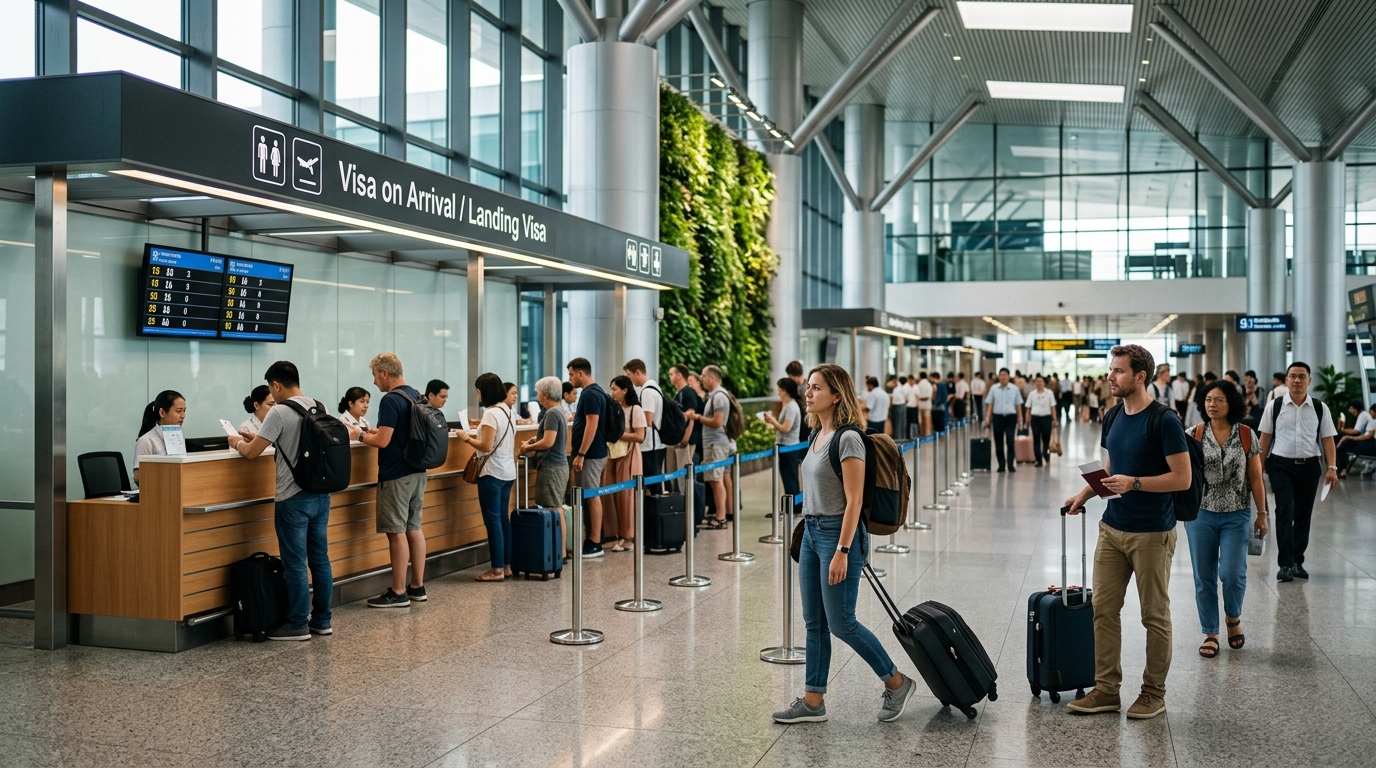
For a Vietnam visa on arrival urgent at Tan Son Nhat (SGN) in 2026, you cannot simply show up and buy a visa at the counter. Visa on arrival (VOA) is now restricted to travellers who already hold a pre-approval letter arranged in advance by a licensed Vietnamese agency, and it works only at the airport. For most independent tourists flying into Ho Chi Minh City on short notice, a super-urgent e-visa is the faster, cleaner, and fully legal route.
Ask online, we answer right awayType your question on this page. No app to install, no number to save.Ask onlineThis page is a practical, airport-specific reference for SGN: who can still use VOA, how fast an urgent approval letter can be issued, exactly what happens at the Landing Visa counter, the cash stamping fee, the NA1 form, the queue reality, and when to skip VOA entirely.
Vietnam visa on arrival urgent at Tan Son Nhat: the short answer for 2026
Here is the honest version, without the marketing gloss:
- VOA is not walk-up. You must have a visa approval letter (also called a pre-approval letter, invitation letter, or cong van) issued before you fly. No letter, no boarding, and many airlines will deny check-in.
- Only a licensed agency can sponsor the letter. An independent tourist cannot self-file for VOA the way you can self-file an e-visa on the government portal. This is why most solo travellers no longer use it.
- VOA is airport-only. It is valid at a small number of international airports, including Tan Son Nhat (SGN) and Noi Bai (HAN), and never at a land border.
- Urgent letters are genuinely fast. As of early 2026, an emergency approval letter for SGN can be issued in as little as 1 to 2 working hours, even on weekends.
If you are simply short on time and want the quickest legal entry, read our comparison of e-visa vs visa on arrival in 2026 before you commit to either.
What “visa on arrival” actually means at SGN in 2026
The name is misleading. “Visa on arrival” does not mean you decide at the airport. It means the stamp is applied on arrival, but the approval happens days or hours earlier.
You still need a pre-approval letter
The pre-approval letter is a document from Vietnam Immigration listing you (and anyone travelling with you) as approved to receive a visa stamp at a named airport. A licensed agency files it on your behalf. You then carry a copy, show it to the airline at check-in, and present it at the Landing Visa counter in Ho Chi Minh City.
Because the letter requires an agency sponsor, independent tourists usually cannot use VOA the way they could a decade ago. The e-visa has replaced it for the vast majority of leisure travellers.
VOA is airport-only, and that matters at SGN
You can only collect a VOA stamp if you land by air at an eligible airport. If your itinerary involves a land crossing (for example, arriving overland from Cambodia and connecting to a domestic flight in Ho Chi Minh City), VOA does not help you. In that case an e-visa, valid at far more ports, is the only practical option.
Same-day and urgent approval-letter timing
The reason people still ask about VOA under pressure is speed. A reputable agency can process the approval letter on tiers similar to an urgent e-visa:
- Standard: typically around 2 working days.
- Urgent: often 4 to 8 working hours.
- Super-urgent / emergency: as little as 1 to 2 working hours during the week, and still achievable on weekends and holidays because agencies operate outside government portal hours.
All of these run on Vietnam Immigration working hours (UTC+7). A “1-hour” letter requested at 3 a.m. Hanoi time does not mean an hour from now; it means roughly an hour of active processing once officials are working. Plan around the clock in Vietnam, not your departure city. For a fuller breakdown of what the fastest tiers really cost end to end, see our guide to the real all-in cost of a 1-hour and 2-hour Vietnam visa.
The SGN Landing Visa counter: a step-by-step walkthrough
Assume your letter is approved and you have landed at Tan Son Nhat. Here is what happens before you reach passport control.
- Follow the immigration signs, then split off. Instead of joining the main “Arrivals / Immigration” queue, look for the “Landing Visa” counter (Cap thi thuc tai cho). At SGN it sits to the side of the immigration hall, before the regular passport-control desks.
- Submit your documents. Hand over your passport, your printed approval letter, your completed entry/exit form, and your passport photos. The officer takes them to prepare the visa sticker.
- Wait for your name. Staff call names (not numbers) when a visa is ready. This is the step most people underestimate, so see the queue reality below.
- Pay the stamping fee in cash. When called, you pay the fee and receive your passport with the visa stamped inside.
- Proceed to passport control. Only now do you join the normal immigration line to be admitted.
What to bring to the counter
- Passport valid at least 6 months beyond entry, with blank pages.
- A printed copy of the approval letter (bring the whole list, not just your line).
- Two passport-sized photos (4×6 cm), taken recently.
- The completed entry/exit form.
- The stamping fee in USD cash.
The USD cash stamping fee
The government stamping fee is fixed and is paid at the counter in cash: around US$25 for single entry and US$50 for multiple entry. Bring clean, undamaged USD notes in the exact amount, because the counter is not a currency exchange and card payment is unreliable. This fee is separate from whatever your agency charges for the approval letter.
The NA1 form
The NA1 is the current entry/exit application form used for the visa stamp; it replaced the older M3 form. You can fill it in on the plane or at the counter, but completing it in advance saves time. Write your details exactly as they appear in your passport and on the approval letter, because mismatches (a middle name dropped, a transposed passport number) are the most common cause of delay at the desk.
Queue reality at Tan Son Nhat
The Landing Visa step is an extra queue on top of normal immigration. On a quiet arrival it can take 15 to 20 minutes. During peak banks of flights, typically early morning (roughly 6 to 8 a.m.) and evening (roughly 5 to 7 p.m.), expect 30 to 45 minutes at the counter alone, before you even reach passport control. If several wide-body flights land together, VOA holders can lose the better part of an hour while e-visa holders walk straight to the immigration line.
The new pre-arrival declaration at SGN
Independently of your visa, Tan Son Nhat introduced a digital pre-arrival declaration on 15 April 2026, which the Vietnamese government describes as encouraged rather than mandatory. It is aimed at all foreign passport holders arriving at SGN, whether e-visa holders, VOA travellers, or visa-exempt nationalities.
- Complete it online (via the immigration department’s pre-arrival portal) once your arrival date is today or within the next two days; ideally finish it before your flight departs.
- It is free and generates a QR code / confirmation to speed up processing.
- It does not replace your visa, your approval letter, or the NA1 form; it is an additional step.
As of mid-2026 this requirement applies at SGN only and is expected to expand to other airports. Treat it as compulsory for Ho Chi Minh City regardless of how you enter.
Why a super-urgent e-visa is usually the faster legal route
For most travellers landing at SGN, the e-visa now beats VOA on almost every axis. Since the December 2025 expansion, the e-visa is valid at around 83 ports of entry (including SGN), issued for single or multiple entry for up to 90 days, and newer e-visas no longer lock you to one fixed port. Crucially, an e-visa holder skips the Landing Visa counter entirely: no cash fee at the airport, no photos, no second queue.
| Factor | Urgent VOA at SGN | Super-urgent e-visa |
|---|---|---|
| Who can arrange it | Licensed agency only (needs sponsor) | Self-file or agency; open to most nationalities |
| Fastest realistic issue | ~1 to 2 working hours (letter) | ~1 to 2 working hours to same day |
| Valid at land/sea borders | No, airport only | Yes, ~83 ports incl. land and sea |
| Airport cash fee | Yes: ~US$25 / ~US$50 in USD | No airport fee |
| Photos required | Yes (2) | No printed photos at airport |
| Airport queue | Extra Landing Visa counter step | Straight to normal immigration line |
If you are racing the clock, an urgent e-visa is usually simpler to stand up, less error-prone at the desk, and portable across your whole itinerary. See the urgent Vietnam e-visa requirements for 2026 for the exact document list, and if you have already applied but it is stuck, read how to expedite a pending e-visa.
When VOA at SGN still makes sense
VOA is not dead, it is niche. It can still be the right call when:
- Your nationality or passport type is not eligible for the e-visa, but an agency can sponsor an approval letter.
- You need a visa type or entry arrangement the e-visa does not cover.
- You are flying into SGN or HAN specifically and value having a licensed agency handle the paperwork end to end.
Landing at Hanoi instead? Our companion reference covers urgent VOA at Noi Bai (HAN). And if your trip falls on a weekend or public holiday, read urgent Vietnam visas on a weekend, holiday or Tet, because timing changes considerably when the government portal is effectively closed.
Do not gamble on an overstay
Whichever route you choose, arrive with valid status. Vietnam tightened its overstay rules in a decree that took effect in December 2025, replacing the older 2021 framework. Fines now scale steeply with the length of overstay, and immigration can order deportation and future entry bans for longer violations. Getting the right visa in time is far cheaper than the penalty, and the details are in our Vietnam visa overstay fines 2026 guide.
Start your urgent application
If you are landing at Tan Son Nhat soon and unsure which path is faster for your passport, the sensible move is to check eligibility now rather than guess at the counter. For the full decision framework, covering every tier, port, and edge case, start with our pillar resource, the complete 2026 guide to emergency and urgent Vietnam visas. When you are ready, begin an urgent application with Vietnam Visa Urgent and we will confirm the fastest legal option for your arrival at SGN.
Ask online, we answer right awayUnusual case, or flying tomorrow? Ask before you order.Ask onlineFrequently asked questions
Can I get a visa on arrival at Tan Son Nhat without a pre-approval letter in 2026?
No. Walk-up visa on arrival is not available at SGN. You must have a visa approval letter arranged in advance by a licensed Vietnamese agency; without it, airlines can deny boarding and the Landing Visa counter cannot stamp your passport. Independent tourists without a sponsor should apply for an e-visa instead.
How fast can an urgent VOA approval letter be issued for Ho Chi Minh City?
A reputable agency can issue a super-urgent approval letter in as little as 1 to 2 working hours during the week, and still process on weekends and holidays. All timing runs on Vietnam Immigration working hours (UTC+7), so plan around the clock in Vietnam rather than your departure city.
What is the stamping fee at the SGN Landing Visa counter, and can I pay by card?
The government stamping fee is about US$25 for single entry and US$50 for multiple entry, paid in cash at the counter. Bring clean USD notes in the exact amount, as card payment is unreliable and the counter does not exchange currency. This is separate from the agency fee for the approval letter.
Do I still need the pre-arrival declaration if I use visa on arrival at SGN?
Yes. Since 15 April 2026, Tan Son Nhat has run a digital pre-arrival declaration online, open to VOA travellers, e-visa holders and visa-exempt nationalities alike. The Vietnamese government describes it as encouraged rather than mandatory, but it is free, takes minutes and does not replace your visa or the NA1 form — so complete it anyway. The portal accepts an arrival date of today or the next two days.
Is an e-visa or visa on arrival faster at Tan Son Nhat?
For most travellers the e-visa is faster overall. Urgent e-visas issue in a similar 1 to 2 hour window, are valid at around 83 ports, and let you skip the Landing Visa counter, the cash fee, and the photos, walking straight to normal immigration. VOA adds an extra counter queue that can run 30 to 45 minutes at peak times.
What is the NA1 form for Vietnam visa on arrival?
The NA1 is the current entry/exit application form used when your visa is stamped at the airport, and it replaced the older M3 form. You can complete it on the plane or at the counter, but filling it in advance saves time. Enter every detail exactly as it appears in your passport and approval letter, since mismatches are the most common cause of delay at the desk.